Paying the tyre fee under the Waste Minimisation (Tyres) Regulations 2023

Information for importers, exporters and manufacturers about when the tyre stewardship fee (the fee) applies, how it is collected, and when invoice corrections or refunds are available. 

Updates from 11 December 2025

From 11 December 2025: 

  • You can claim a refund of the fee paid on a tyre that is exported from New Zealand if it is either attached to a motor vehicle or aircraft or intended for use on one.  
  • The eligibility criteria for refund claims under exemption 11(6) has been amended to prevent unfunded tyres entering the take-back service. 

About the fee

From March 2024, importers and onshore tyre manufacturers must pay the fee on regulated tyres when they enter the New Zealand market.

The Ministry for the Environment (the Ministry) and the NZ Transport Agency Waka Kotahi (NZTA) are responsible for collecting the fee. 

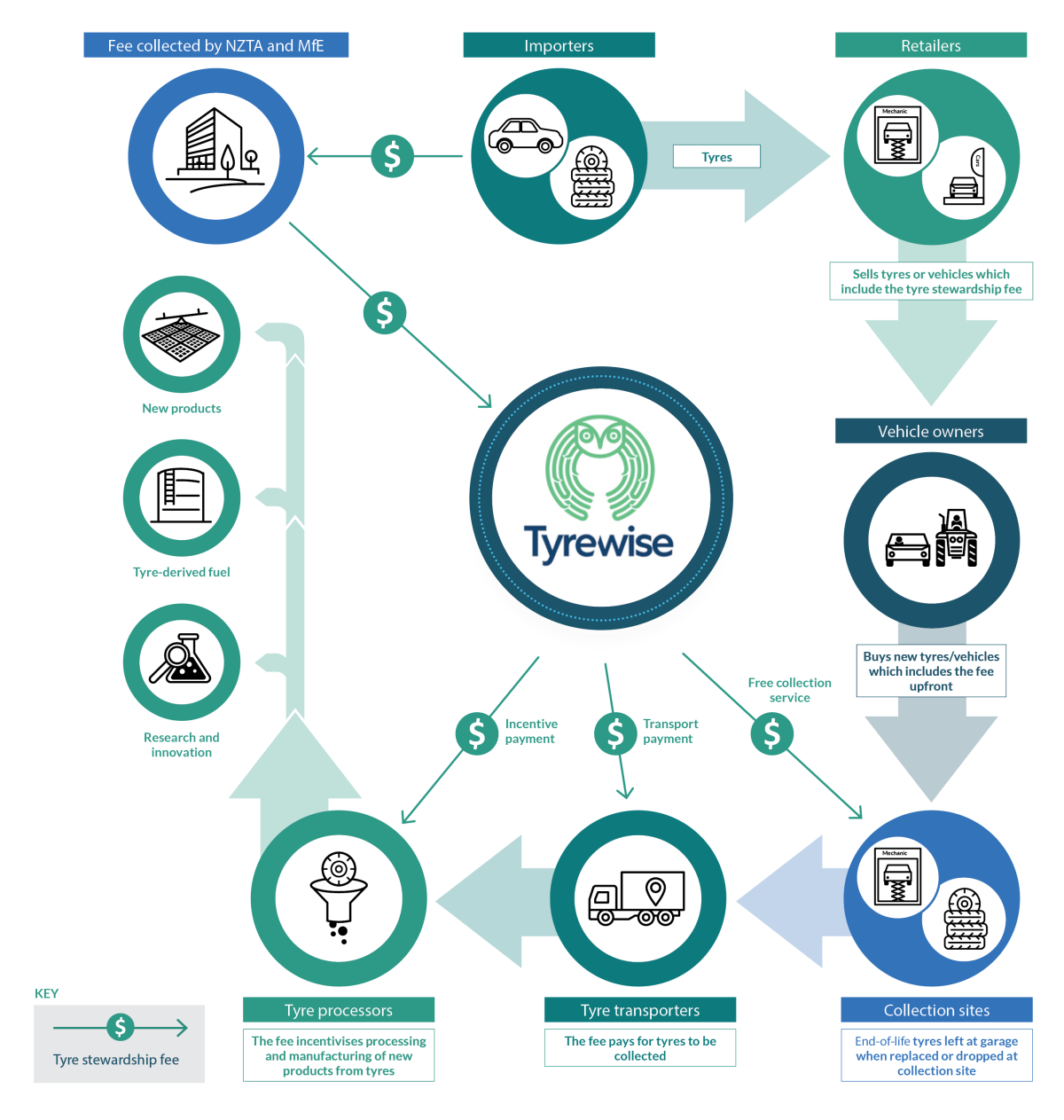
A detailed infographic explaining the cycle of Tyrewise.

The circular Tyrewise cycle is: 

  • The Ministry and NZTA collect the tyre stewardship fee from importers. The revenue funds the stewardship scheme known as Tyrewise.  
  • Importers sell tyres/vehicles to retailers with the fee included. 
  • Retailers (such as mechanics or vehicle dealerships) sell tyres/vehicles to vehicle owners with the fee included.  
  • Collection sites receive tyres once they have reached end of life. These sites include mechanics, as well as public collection sites (transfer stations, community recycling centers etc).  
  • Tyrewise uses the fee to provide a free collection service for end-of-life tyres. Tyrewise pays public collection sites a nominal fee.  
  • Tyrewise pays transporters to collect end-of-life tyres from collection sites and deliver them to processors.  
  • Processors turn end-of-life tyres into new products. Tyrewise uses the fee to incentivise processing and manufacture of new products from end-of-life tyres. 
  • Shredded end-of-life tyres are used to make new products such as play matting, as well as being used for tyre-derived fuel, or in research and innovation.  
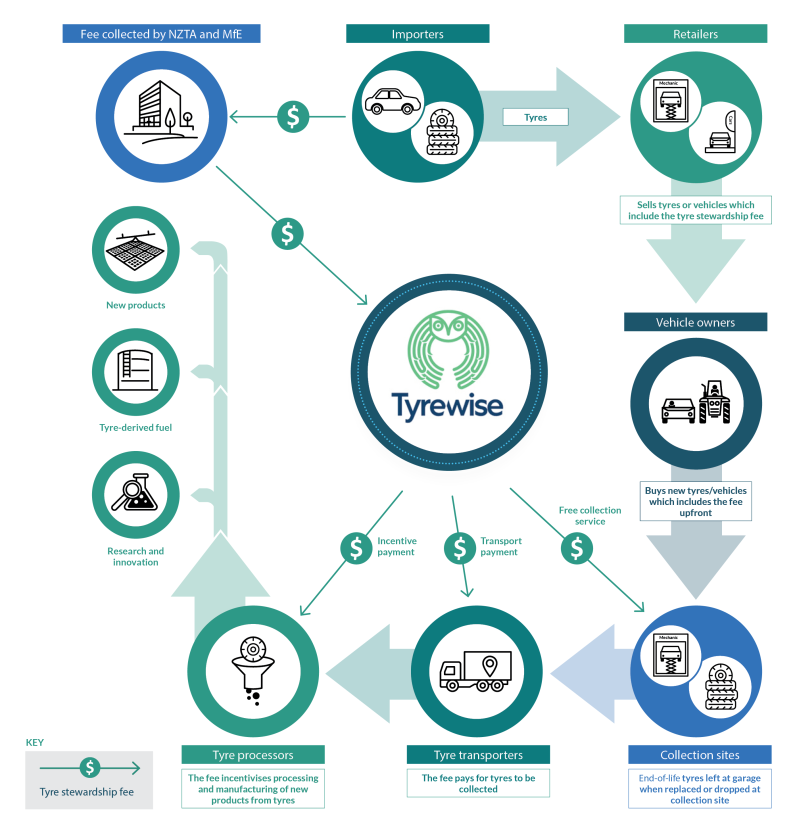
A detailed infographic explaining the cycle of Tyrewise.

The circular Tyrewise cycle is: 

  • The Ministry and NZTA collect the tyre stewardship fee from importers. The revenue funds the stewardship scheme known as Tyrewise.  
  • Importers sell tyres/vehicles to retailers with the fee included. 
  • Retailers (such as mechanics or vehicle dealerships) sell tyres/vehicles to vehicle owners with the fee included.  
  • Collection sites receive tyres once they have reached end of life. These sites include mechanics, as well as public collection sites (transfer stations, community recycling centers etc).  
  • Tyrewise uses the fee to provide a free collection service for end-of-life tyres. Tyrewise pays public collection sites a nominal fee.  
  • Tyrewise pays transporters to collect end-of-life tyres from collection sites and deliver them to processors.  
  • Processors turn end-of-life tyres into new products. Tyrewise uses the fee to incentivise processing and manufacture of new products from end-of-life tyres. 
  • Shredded end-of-life tyres are used to make new products such as play matting, as well as being used for tyre-derived fuel, or in research and innovation.  

Loose tyres

The Ministry collects the fee from importers of loose tyres as per section 9 of the tyre regulations (NZ Legislation).

Paying the fee

You will receive a monthly invoice for tyres imported in the previous month.

The Ministry uses the New Zealand Customs Service (Customs) tyre import entry data, shared under an Information Disclosure Agreement, to calculate invoices.

Pay the invoice by the 20th of the following month via bank transfer or approved direct debit. Automatic adjustments for Customs entry changes or cancellations are processed the month after the data has been updated. 

To update your billing information or if you believe your invoice is incorrect, contact accounts@tyrefee.govt.nz or call 0800 500 034.

For non‑accounts queries, email ps.schemes@mfe.govt.nz.

Exemptions and refunds

The fee is not collected on consignments that have a Customs value ≤ $1,000 or that are transhipped. 
 
If you are exporting tyres from New Zealand from 11 December 2025, whether attached to a motor vehicle (includes trailers) or aircraft, or intended for use on one, you may request an invoice correction or a refund.  
 
If the fee was charged twice on the same loose tyre(s), or charged in error on a non-regulated tyre, you may request an invoice correction or refund. 
 
See Applying for an invoice correction or a refund for evidence requirements and how to submit a claim.  

Choosing the right tariff code 

The fee categories for loose tyres are based on an average equivalent passenger unit (EPU) for each tariff code. The process for selecting the correct tariff code has not changed and is administered by Customs.  

See Customs guidance to help you classify common loose tyres:

Road-registered vehicles

NZTA collects the fee when a motor vehicle (as defined by the Land Transport Act section 2) is first registered in New Zealand as per section 11 of the tyre regulations (New Zealand Legislation).

Paying the fee

The fee appears on the vehicle registration label tax invoice. 
 
The fee is not charged in subsequent registration renewals or at change of registered person. 
 
For guidance on how to road-register your newly imported motor vehicle, please visit the NZTA website
 
If you believe you have been charged the fee incorrectly for your motor vehicle class, contact NZTA. 

Exemptions and refunds

You may be eligible for a refund from the Ministry if: 

  • tyres are exported attached to a road-registered vehicle (includes trailers) from 11 December 2025 
  • a loose tyre fee was paid, and that tyre was later attached to a vehicle and charged the fee again at first road-registration 
  • the vehicle functioned as an off-road vehicle (fee already paid) before first road-registration.

See Applying for an invoice correction or a refund for evidence requirements and how to submit a claim. 

Off-road vehicles and aircraft

The Ministry collects the fee for tyres imported attached to off-road vehicles and aircraft as per sections 10 and 11 of the regulations (New Zealand Legislation).

Paying the fee

Off-road vehicle and aircraft importers must declare vehicles, aircraft and tyre imports, using the Tyrewise self-declaration form
 
The Ministry issues quarterly invoices based on the declarations. 
 
This includes importers of ATVs, forestry and farming machinery, construction, and civil engineering vehicles or aircraft.  

Exemptions and exceptions

You may be eligible for a refund from the Ministry if: 

  • tyres are exported attached to an off-road vehicle (includes trailers) or aircraft from 11 December 2025 
  • the vehicle functioned as an off-road vehicle (fee already paid) before first road-registration.

You are not required to pay the fee if the aircraft is a good or class of good that is exempt from the requirements of section 75(1) of the Customs and Excise Act 2018 by regulations made under section 405(d) of that Act (New Zealand Legislation)
 
See Applying for an invoice correction or a refund for evidence requirements and how to submit a claim.  

Onshore tyre manufacturers

There are currently no onshore manufacturers of regulated tyres in operation. If onshore manufacturing of regulated tyres begins, manufacturers must self-declare sales of regulated tyres. The Ministry will collect the fee on tyres manufactured and sold on the New Zealand market as per section 12 of the tyre regulations (New Zealand Legislation).

A regulated tyre that is retread in New Zealand is not considered to be manufactured in New Zealand and does not incur the fee at this point.

What happens if you do not pay the fee

If you are required to pay the fee and you do not, you may be:

  • prosecuted
  • fined up to $100,000 under the Waste Minimisation Act (2008).

The Ministry issues payment reminders before any enforcement action is taken.

Setting up a direct debit

As an importer of regulated tyres, you may wish to pay the fee via direct debit.

To authorise a direct debit, download, complete and email the form to TSFaccounts@mfe.govt.nz

Download the direct debit authority form

Tyre stewardship fee: direct debit authority form (DOCX, 80.7KB)

Applying for an invoice correction or a refund

To request an invoice correction or a refund, you must provide sufficient evidence, as required by section 14. This section covers invoice corrections and refunds, where a fee has been charged and you meet eligibility criteria. 

Adjusted or cancelled loose tyre import entries are processed automatically each month using Customs data – no claim needed.

Eligibility and evidence

You may request an invoice correction or a refund if you satisfy the exemption criteria set out in sections 8(3), 9(3), 10(4), 11(6), or 11(7), of the regulations. The information below outlines common exemption scenarios. Please provide the necessary evidence with your application.

Exported tyres (from 11 Dec 2025)

What this covers
  • Tyres exported from New Zealand attached to a motor vehicle (includes trailers) or aircraft, or intended for use on one (Reg 8(3)).
  • Exported end-of-life/waste tyres are not eligible.
Evidence you must provide 
  • Proof of fee invoiced/paid 
  • Export clearance from Customs 
  • Proof of destination country acceptance 
  • Proof of use/intended use on a vehicle/aircraft (e.g. manufacturer schematic, buyer declaration/photos, recall/shipments docs, temporary import docs). 

Loose tyre attached to a vehicle and charged the fee again at first road-registration

What this covers
  • The fee paid on a loose tyre, and that tyre was later attached to a vehicle and charged the fee again at first road-registration (Reg (11(6)).
  • However, a tyre replacing a tyre imported attached a vehicle that is non-compliant with vehicle standards is not eligible for a refund. 
Evidence you must provide 
  • Evidence that demonstrates the tyres are not replacing tyres imported attached to the vehicle that are non-compliant with vehicle standards.
  • Supplier documentation showing: 
    • vehicle identifiers (VIN/chassis/engine) 
    • fee paid and purchase date (invoice/receipt) 
    • NZTA registration documentation showing: 
    • plate number(s) 
    • fee paid and purchase date (receipt).

Off-road vehicle purchased and charged the fee again when first road-registered

What this covers

The fee already been paid on a vehicle which functioned as an off-road vehicle before being road-registered for the first time (Reg 11(7)).

Evidence you must provide
  • Supplier documentation showing: 
    • vehicle identifiers (VIN/chassis/engine) 
    • fee paid and purchase date (invoice/receipt) 
    • NZTA registration documentation showing: 
    • plate number(s) 
    • fee paid and purchase date (receipt). 

How to apply

  1. Download the refund application form.
  2. Complete the form and attach your evidence. 
  3. Email your application to accounts@tyrefee.govt.nz
  4. We aim to process complete applications within 30 business days. 

If you were charged the fee for a non-regulated tyre (tyres for non-motorised vehicles or equipment eg, wheelbarrow tyres), a vehicle without tyres, or due to an administrative error, please also use the claim form and provide supporting evidence.

Download the refund application form

Tyre stewardship fee: Claim form (DOCX, 111KB)
Who to contact

Query topic Contact

Accounts and invoices, including: 

  • Invoice corrections or refund claims 
  • Updating your billing contact information.

The Ministry’s Tyre Fee Accounts Team

accounts@tyrefee.govt.nz

0800 500 034

Regulated product stewardship and policy

The Ministry’s Resource Efficiency Policy team 

ps.schemes@mfe.govt.nz

Vehicle registration or motor vehicle classes Please visit the NZTA website.