Product stewardship regulations for agrichemicals, their containers, and farm plastics

Feedback received during public consultation was supportive of regulations to enable implementation of the accredited product stewardship scheme for agrichemicals, their containers and farm plastics.

Government has now agreed to drafting these regulations.  

About the regulations being drafted

The regulations will build on the voluntary schemes that have been operating for nearly 20 years. This will establish a nationally consistent product stewardship scheme for agrichemicals, their containers and farm plastics by helping farmer, growers and other consumers of these products to:

  • cut waste
  • reduce environmental impact
  • enable productivity.

Overview of the accredited scheme when supported by regulations

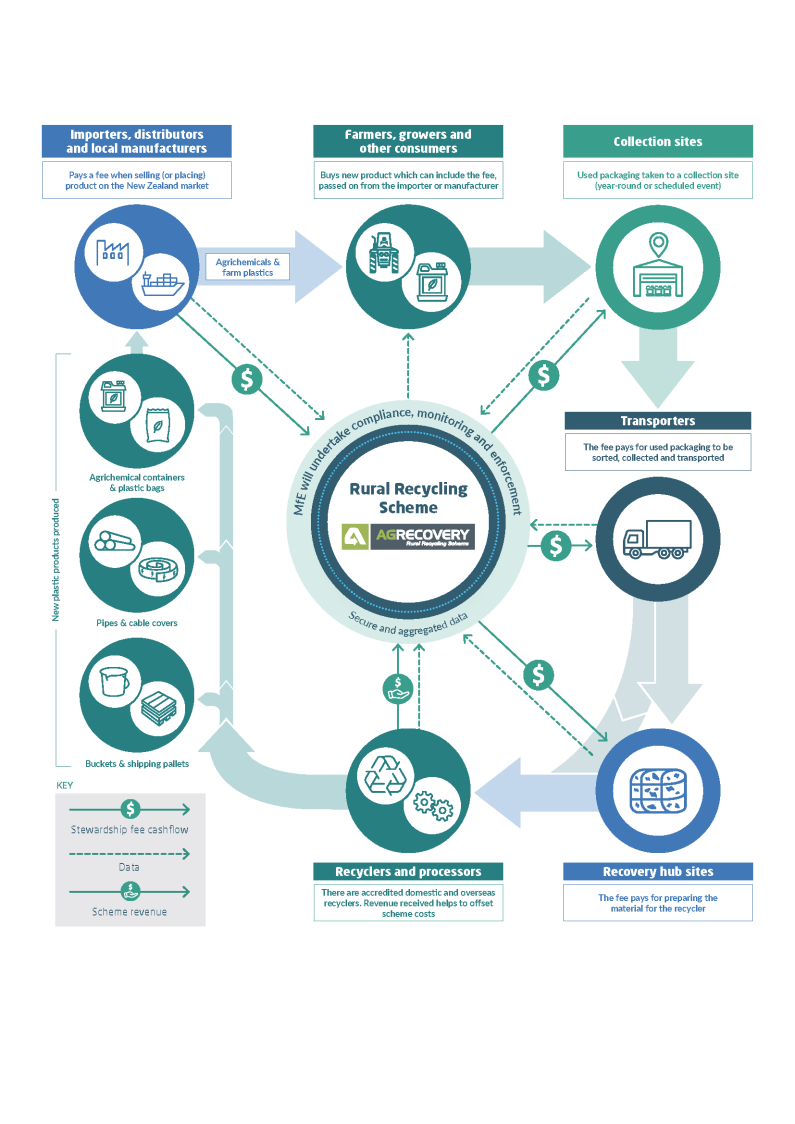
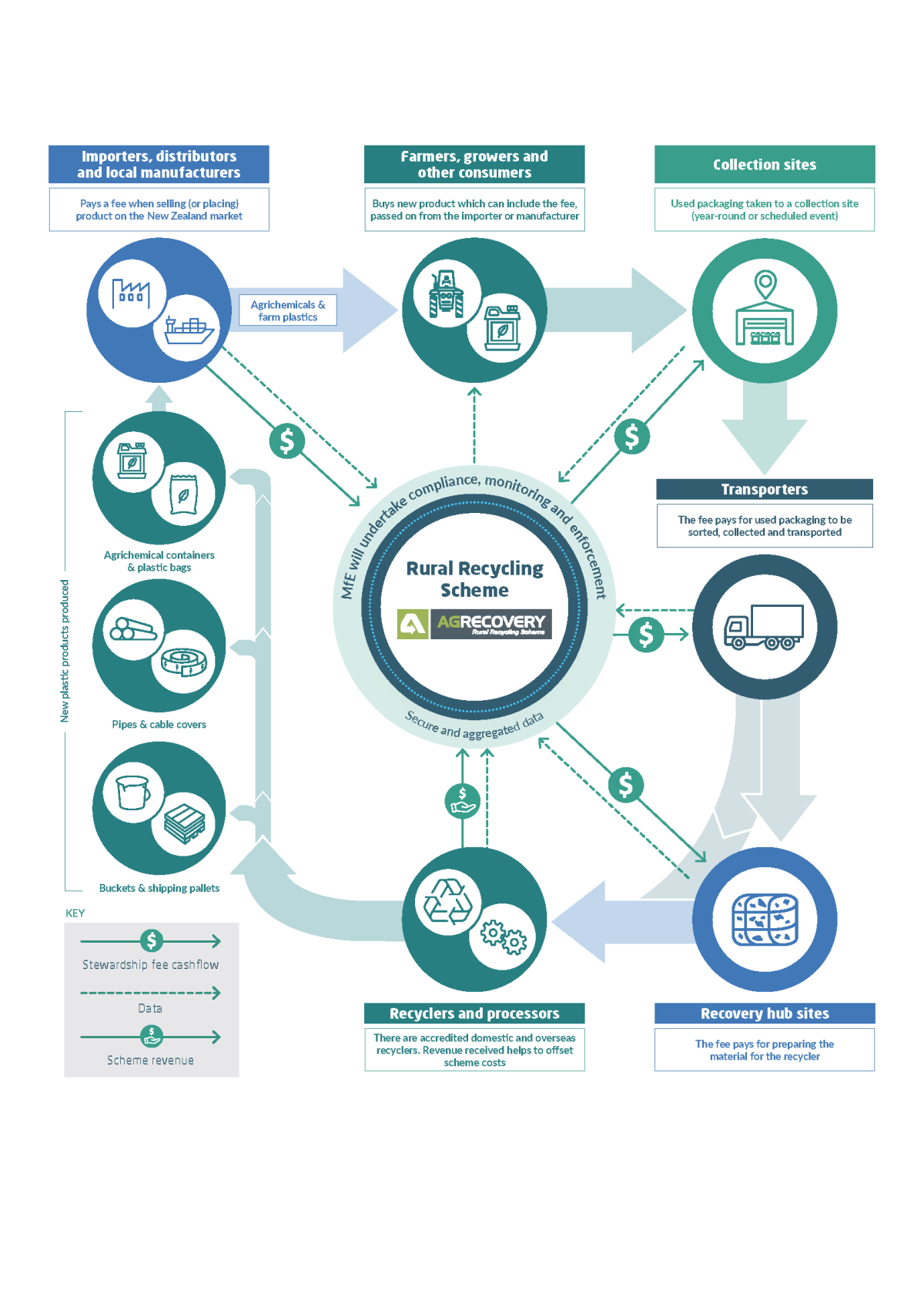
The accredited scheme, named the 'Rural Recycling scheme', will require the producers of in-scope products to declare their sales and then pay regulated fees in proportion to the declared sales volumes. The accredited scheme is run by the Agrecovery Foundation, a not-for-profit charitable trust.

When the consumer (farmers, growers and others) has used the product, they will have the option of a free-to-use recycling service for those plastic products and containers. 

The recycling (take-back) service will be primarily funded by the fees collected from the producers of the in-scope product.

J001517 MfE   Infographic   Rural Recycling scheme 2.2 PA

Products in scope of the scheme

  • Agrichemicals sold in plastic containers and drums of 1,000 litres or less (including household pest and weed control products) 
  • all plastic bale wrap and silage sheets  
  • plastic bags containing completed agricultural products including, but not limited to seed, feed, fertiliser, soil and crop inputs and farm and animal supplements, in either:
    • small plastic bags (16-40 kilograms when full)
    • large woven polypropylene bags (over 40 kilograms when full). 

See further information around in-scope products including changes made following consultation and general information of the Rural Recycling Scheme.

Scheme changes following public consultation

The name of the accredited scheme has been changed from Green Farms to the Rural Recycling Scheme. Feedback received suggested that the name needs to better reflect the nature of the scheme and what it aims to achieve. 

Changes to the product scope include:  

  • A minimum size of 16 kilograms for small plastic bags has been introduced, and  
  • the definition of agricultural products has been clarified to ensure plastic bags containing household garden products such as potting mix and compost are excluded.   

These changes were made to avoid products that are more likely to be used by households, from being captured by the regulations.  

Take-back services to be provided by the scheme

The Rural Recycling Scheme take-back model will include: 

  • fixed drop-off sites at convenient locations including at rural-sector retailers, 
  • non-fixed schedule events, and  
  • collections on-farm or nearby (for remote areas).

Consumer participation with the scheme

Many farmers and growers already utilise take-back services available. We expect more will use the free and convenient services provided by the Rural Recycling Scheme. 

However, farmers, growers, and other consumers of the in-scope product are not required to use the take-back services provided by the Rural Recycling Scheme. They will be encouraged to.

How the scheme will change the status quo

  Status quo - voluntary product stewardship Rural Recycling Scheme supported by Regulations
Fees paid by producers

Some producers pay the voluntary schemes a fee to help fund the take-back services provided for their products.  

Other services are user-pays and are subsidised by a producer or local government. 

Fees (a levy) will be paid by producers of all in-scope products to cover the full-service costs. Fee collection will fund a nation-wide take-back model. 
National coverage

The voluntary schemes cover a good proportion of the country, but some regions and remote areas remain without access to take-back solutions. 

Other commercial enterprises may provide take-back services in some regions at a cost.  

The take-back scheme will be distributed across the country providing free-to-use and convenient take-back options across all regions.  For remote locations, on-farm or nearby collections may be utilised instead of fixed collection sites. 
Free riders Free riders who utilise take-back services without contributing to running costs, exist under the voluntary schemes.  

There will be no opportunity for free riders as all producers of in-scope product will be required to pay a fee.   

Both the scheme manager and the Ministry will be involved in compliance monitoring and enforcement, ensuring all producers pay the fee. 

Convenience for farmers Farmers who use multiple in-scope product types, may need to engage with both voluntary schemes (where available) or other take-back services in order to recycle their waste. 


Farmers who use multiple in-scope product types, may need to engage with both voluntary schemes (where available) or other take-back services in order to recycle their waste. 

Take-back solutions for all in-scope product will be provided by one unified scheme, providing a one-stop-shop approach with more convenient take-back options  

Scheme fees

The scheme fees are below. These have not changed following consultation. The fees typically range from less than 0.2 percent up to around 1.7 percent (and generally less than 1 percent)  

Proposed stewardship fee rates

Category Product Fee rate ($)
Agrichemicals and their containers Packaging part of fee Per litre
Containers up to 60 litres 0.10
Containers over 60 litres, and less than Intermediate Bulk Containers (IBC) 0.025
IBC (approx. 1,000 litres) 0.02
Chemical part of fee Per litre
Group 1 – chemicals unlikely to be brought for disposal (the consumer typically uses them up) 0.01
Group 2 – chemicals with lowest disposal cost 0.03

Group 3 – chemicals with higher disposal cost 

  • In containers up to 60 litres 
  • In containers of 60 litres or more


0.04 

0.06 

Household pest and weed control products  
Cost per container   0.10
Group 1 - Chemicals unlikely to be brought for disposal (per kilogram or litre) 0.02
Group 2 - Chemicals with lowest disposal cost (per kilogram or litre) 0.08
Group 3 - Chemicals with higher disposal cost (per kilogram or litre) 0.10
Farm plastics Bale wrap and silage sheet Per tonne
Bale wrap 462.021
Silage sheet 462.02 
Bags Per bag
Small bags 0.20
Large bags 3.58

Table 2 Examples of fees relative to product cost

Product Fee (per unit) Typical purchase price (per unit) of a full product Fee as a percentage of cost
Bale wrapped feed $0.52 $30-$60 per bale 0.87 - 1.73
Large fertiliser bag $3.58 $400-$1000 per bag 0.36 – 0.9
Small feed or fertiliser bag $0.20 >$100 per bag <0.2
20-litre container of agrichemicals in group 2 $2.60 Ranges widely, e.g. $181-$1,516 for products of the biggest provider of agrichemicals in New Zealand 0.7 – 1.4

Who will pay the scheme fees

The producer of the in-scope products will pay the fees. A producer can include manufacturers, importers and distributors who are responsible for placing the in-scope product on the New Zealand market. Producers will be required to register with the scheme and declare how much product they have sold before paying the proportional amount of fees. 

Will the fee be passed to the consumer

For many in-scope products, the fee is likely to be passed onto the consumer. Some large retailers are already committed to the voluntary schemes which includes a fee paid per product. Where this is occurring, it is unlikely that regulated fees will be passed onto the consumer as voluntary fees of a similar amount are already factored into their product retail prices. 

Who will receive the scheme fees

The fees will be paid to the accredited scheme after the producer declares the amount of in-scope product placed on the New Zealand market

Distinguishing between in-scope and out-of-scope products

Regulations will include clear definitions that distinguish in and out-of-scope products. 

Users will be supported through clear communication from Agrecovery, including guidance on the scheme’s website, through retailers, and at the point of sale.  

The scheme will roll out clear, targeted communications across all regions, ensuring retailers, farmers and other users know exactly what is in scope, how to return it, and why it matters. 

While labelling will not be mandated, where it is relevant to do so, many already voluntarily include the scheme logo for easier identification.  

Household pest and weed products

Household pest and weed products (a type of agrichemical) are not typically used by farmers and growers and are instead used by residential households.  

Chemical residues in these products require special handling which aligns with Agrecovery’s experience, relevant expertise and the scheme’s accreditation. Agrecovery has worked with supply chain stakeholders to design a take-back scheme and are best placed to implement this with the support of regulation.

What happens to collected plastics 

The scheme will actively pursue markets to obtain the best possible price for recovered materials. This means there’s a mix of domestic processing and exports.   

Currently, collected containers are recycled in New Zealand, while bags, bale wrap, and silage sheet are exported to recycling facilities offshore.   

HDPE containers are re-processed into new products, such as underground cable cover.   

Silage wrap is often turned into products such as Tuffboard, building insulation, and moisture barriers.   

Recycled plastic from woven polypropylene (PP) bags are typically used in the production of new woven PP products.   

Monitoring and evaluation of the scheme

The scheme will be required to operate in accordance with its accreditation. This includes several objectives and targets relating to its performance and effectiveness. The scheme manager will be required to report on its performance at set intervals (e.g. annually) to the Ministry.

Cost recovery for the Ministry's performance monitoring costs of the scheme

The Ministry will monitor the performance of the scheme and recover the monitoring costs from the scheme manager (up to 1 FTE), using part of the stewardship fee revenue.  

About the current voluntary schemes

Two schemes currently collect about half of the estimated total quantity of agrichemical containers, bale wrap, and silage sheet sold in New Zealand.

Agrecovery

Agrecovery operates a drop off scheme for agrichemical containers and small plastic bags and provides a take-back service for residual agrichemicals.  Agrecovery has around 200 collection sites already, mostly at retailer sites such as Farmlands and PGG Wrightson.

Plasback

Plasback operates a user-pays scheme for collecting some farm plastics, mainly bale wrap and silage sheet.  

Impact of regulations on the voluntary schemes

Once regulations are in place to support the Rural Recycling Scheme, most services currently offered by the voluntary schemes will no longer be needed. However, the voluntary schemes, or other commercial enterprises may still provide take-back solutions at a cost to the users.  Solutions may include:  

  • products that are not included in the regulated scheme scope, 
  • product that is not eligible for take-back services such as legacy (unlabelled) agrichemicals, 
  • residual agrichemicals in large amounts (over 30L/kg), and 
  • premium services such as on-farm collection for consumer who want them.  

What's next

The Ministry is working with the Parliamentary Council Office to draft the regulations.  The final draft regulations for agrichemicals, their containers, and farm plastics are expected to be brought back to Cabinet for decision mid-2026.

If the Government approves, the draft regulations will come into force 6-12 months after publication.  Likely to be late 2026, early 2027.

Contact us

If you have any further questions, please email rps@mfe.govt.nz.