Product stewardship regulations for agrichemicals, their containers, and farm plastics

On 7 September 2027, the Minster for the Environment announced regulations that establish and support the Rural Recycling Scheme.

See media release for new nationwide rural recycle scheme (Beehive website)

About the regulations and the Rural Recycling Scheme

The regulations will establish the Rural Recycling Scheme, which was developed by agricultural sector groups to improve recycling services for farmers and other users of agrichemicals and farm plastics. 

Supported by regulations, the scheme will combine services of the two voluntary schemes, Agrecovery and Plasback, into one nationwide scheme. 

The regulations will require all producers of regulated products to register with the scheme and pay a small fee on each product sold. These fees will fund a convenient nationwide take-back service, operated by Agrecovery, for farmers, growers, and other users of regulated products. 

Expanding access to take-back services will benefit the environment by reducing the amount of farm plastic sent to landfill, buried, or burnt on farms.

Scheme commencement

The scheme starts on 1 March 2027.

Products being regulated

  • Agrichemicals1 sold in plastic containers or drums of 1,000 litres or less (including household pest and weed products). 
  • Plastic bale wrap and silage sheets. 
  • Agricultural products2 sold in:  
    • Plastic bags weighing 16–40 kg, and 
    • Woven polypropylene bags weighing over 40 kg. 

1 agrichemical means a liquid or solid substance used to:

  1. manage plants or livestock; or
  2. control pests; or
  3. regulate plant or livestock health; and
  4. excludes—
  5. products supplied in aerosol form;
  6. detergents and sanitisers; 
  7. vertebrate toxic agents; and
  8. products intended for domestic use (except for products used in controlling pests or weeds in a home or garden)

agricultural product means:

  1. seeds used for sowing, including pasture, arable, horticultural, and specialised crop seeds:
  2. livestock feeds, including grain-based rations and specialised feeds:
  3. fertilisers, including conventional and speciality fertilisers, used to enhance horticultural production or crop and pasture growth:
  4. soil and crop inputs used to improve soil structure, fertility, or productivity (excluding home garden products):
  5. supplements provided in addition to livestock feed and used to support livestock health, performance, and nutrition
What is required of producers of regulated product

Producers selling regulated products in New Zealand must register for the scheme, declare the amount of regulated sales every quarter and paying a regulated fee.  

See Agrecovery’s website for information on registration.

Fees for regulated products

Category Product Fee rate ($)
Agrichemicals and their containers Agrichemicals, excluding household pest and weed control products  
Packaging part of fee   Per litre or kg   
Containers up to 60 litres/kg 0.10  
Containers over 60 litres/kg, and less than Intermediate Bulk Containers (IBC)  0.025 
IBC (approx. 1,000 litres/kg)    0.02  
Chemical part of fee Per litre or kg
Group 1 0.01
Group 2 0.03

Group 3  

  • In containers up to 60 litres/kg 
0.04
  • In containers of 60 litres/kg or more  
0.06

Household pest and weed control products  

Packaging part of fee

Cost per container

0.10

Chemical part of fee

Per litre or kg

Group 1

0.02

Group 2

0.08

Group 3

0.10
Other farm plastics


Bale wrap and silage sheet

Per tonne

Bale wrap

462.02 (or approximately 52 cents per bale)  

Silage sheet

462.02

Bags

Per bag

Small bags

0.20

Large bags

3.58

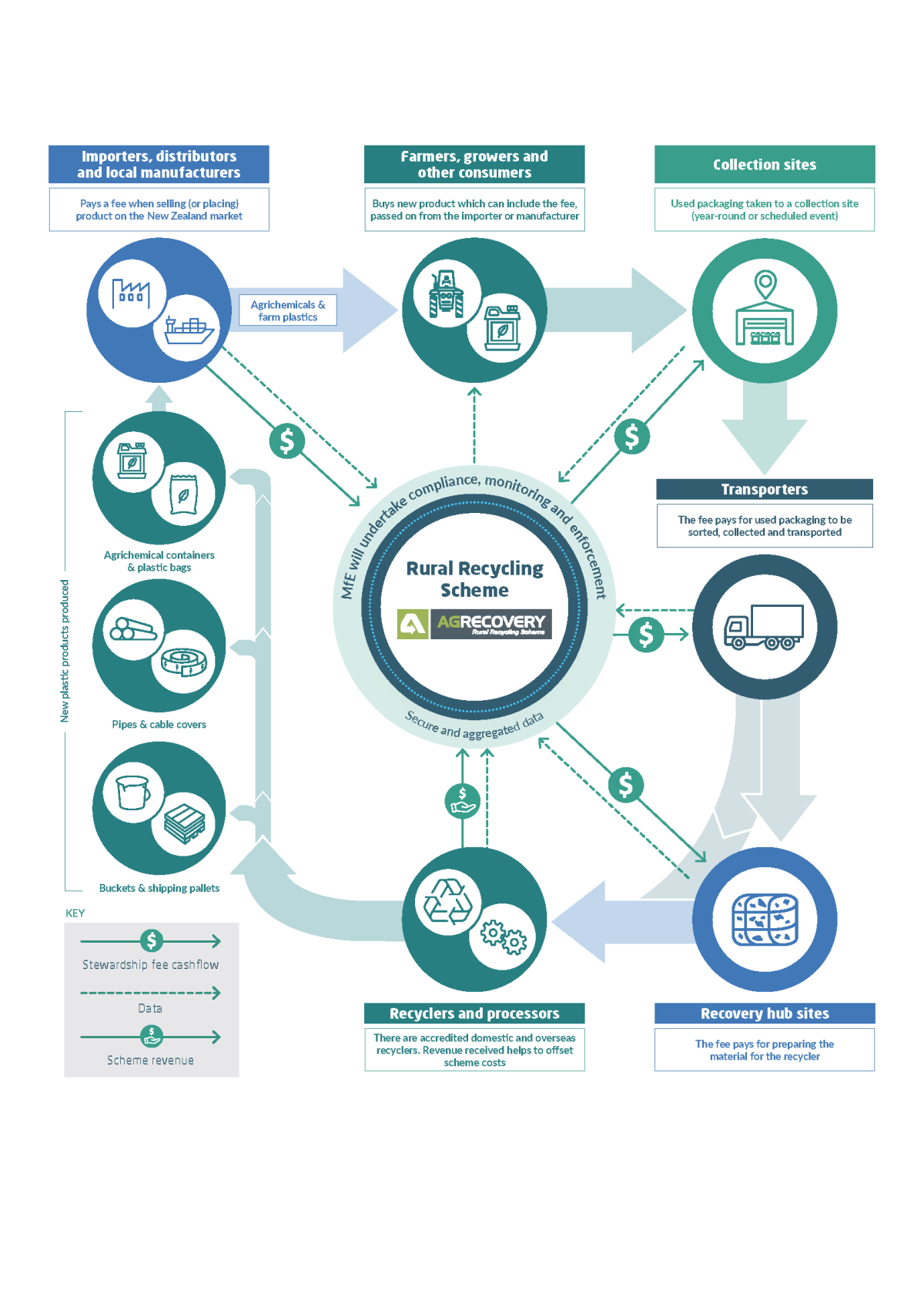
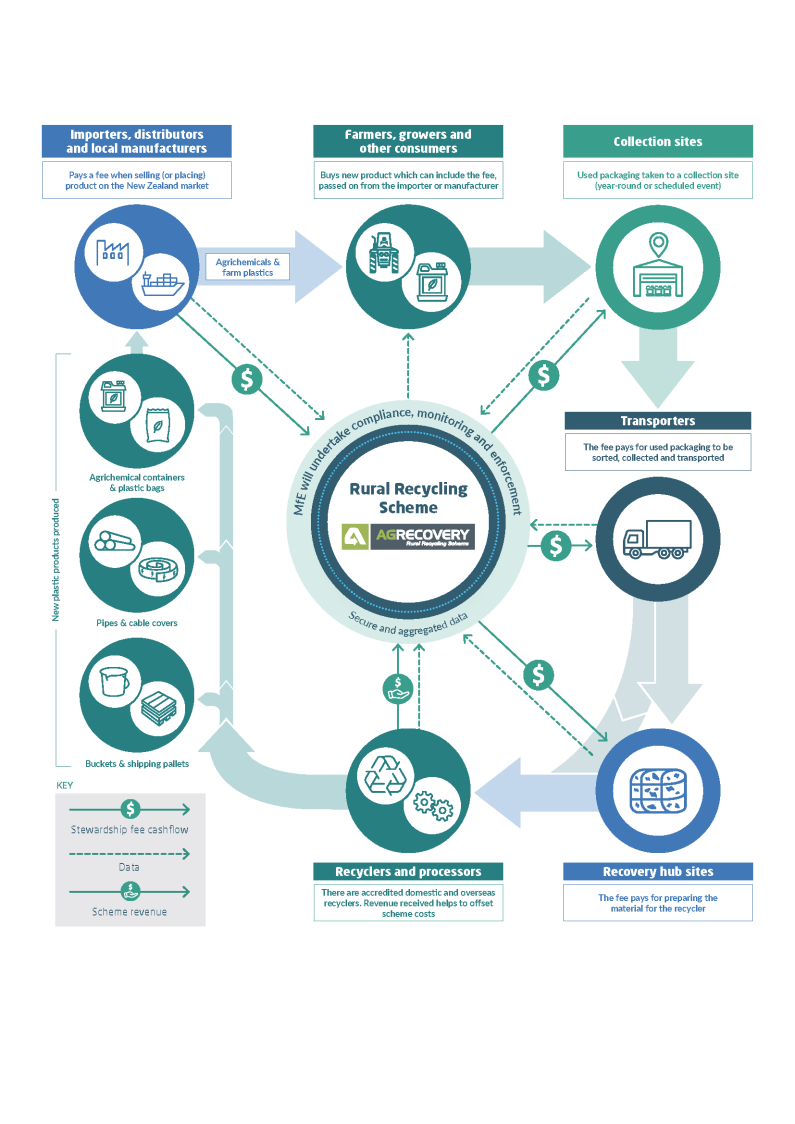
Overview diagram of how the scheme works

The 'Rural Recycling scheme', will require the producers of in-scope products to declare their sales and then pay regulated fees in proportion to the declared sales volumes. The accredited scheme is run by the Agrecovery Foundation, a not-for-profit charitable trust. 

When the consumer (farmers, growers and others) has used the product, they will have the option of a free-to-use recycling service for those plastic products and containers.  

The Rural Recycling Scheme take-back service will be funded by the regulated fees collected from the producers of the in-scope product. 

J001517 MfE   Infographic   Rural Recycling scheme 2.2 PA

Many producers already voluntarily contributing to the cost of Agrecovery or Plasback’s services

Once a product becomes regulated (from 1 March 2027), the voluntary fees paid into the scheme by producers will be replaced by regulated fees. All producers must register with the regulated scheme operated by Agrecovery and pay the regulated fees from 1 March 2027.

For products that are not regulated, Agrecovery may continue to provide voluntary or user pays take-back services outside the regulated scheme.

Agrecovery may also offer user-pays services, such as on-site collection of farm plastics or residual agrichemicals that are not eligible for the free Rural Recycling Scheme collection. Please contact Agrecovery for more information about user-pays options for non-regulated products as well as collection criteria for residual agrichemicals.

The take-back service

The take-back service for regulated products will expand over time. It will collect and recycle farm plastics once they reach the end of their life and become waste. The service will include a network of convenient, accessible, and free-to-use drop-off sites and collection options.

What happens to collected farm plastics

The scheme will seek the best available markets for recovered materials to maximise their value, make fee revenue go further, and keep costs down. This will involve a mix of domestic processing and offshore recycling. Currently, collected containers are recycled in New Zealand, while bags, bale wrap, and silage sheet are exported to overseas recycling facilities.

Returning plastic waste products to the scheme

It is not mandatory for users to return their plastic waste to the scheme, via the take back service.  

The scheme’s take-back services are free-to-use and have been informed by farmer and grower feedback, including on the existing schemes. The new systems have been trialled in Southland and Canterbury and further refined. As the new scheme rolls out, systems will be further refined for each region, making it easier for famers and growers to ‘do the right thing’ with their plastic waste.  

Contact

For more information about regulated products, signing up for registration, fees and the take-back service, please visit the Agrecovery website