Voluntary nature and carbon markets in New Zealand
The Government is backing the growth of trusted, privately run voluntary nature and carbon markets in New Zealand.
The Government is backing the growth of trusted, privately run voluntary nature and carbon markets in New Zealand.
Privately run voluntary nature and carbon markets allow private money to fund projects that restore nature or remove greenhouse gases.
That can include work such as:
Such projects can generate credits for protecting nature and taking climate action.
When a landowner or project developer undertakes a project, they can register the project under a scheme which measures progress. If the New Zealand Government endorses the scheme as high quality, landowners can be confident their land will be used for robust, credible and independently checked environmental outcomes. Credits can then be issued and sold to organisations or individuals wanting to back environmental outcomes with evidence behind them, with the money returned to the landowner.
These markets can create opportunities for farmers, landowners, iwi, Māori, community groups and project developers, while helping attract private investment into nature and climate action in New Zealand.
High-integrity markets are designed to support nature and climate projects and give participants confidence that environmental claims are credible.
The diagram below shows what a trusted voluntary nature and carbon credit system looks like.
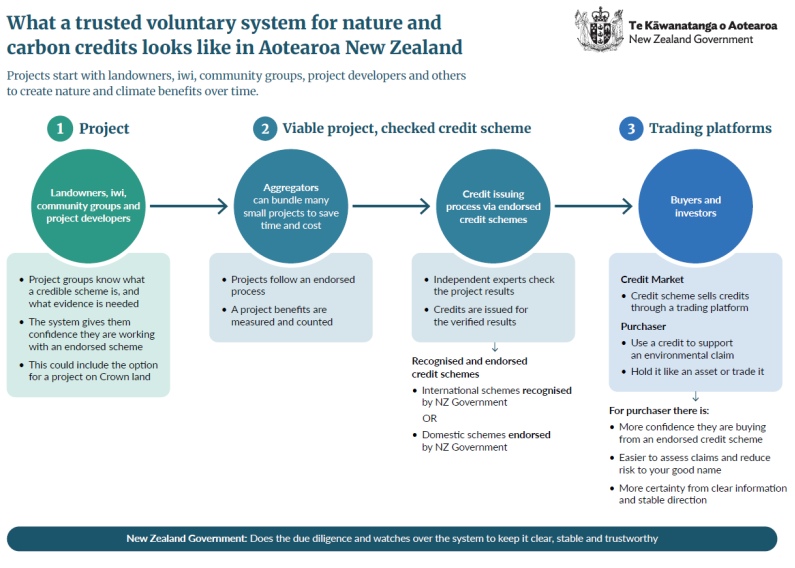
The Government is supporting the growth of voluntary nature and carbon markets by recognising and endorsing high-quality schemes in privately led markets.
The aim is to build trust and make it easier for buyers, landowners and project developers to identify credible options.
The Government’s approach has two pathways:
Endorsement is a quality signal, not a Crown guarantee. Buyers still need to do their own due diligence, and private transactions remain private matters.
Schemes that are not recognised or endorsed can still operate, but market participants will need to do their own checks on quality and credibility.
Recognition signals which internationally accredited schemes meet the standard expected for participation in New Zealand’s voluntary nature and carbon markets.
Recognition of qualifying international accreditation bodies takes effect immediately. They are the Integrity Council for the Voluntary Carbon Market (ICVCM), Carbon Offsetting and Reduction Scheme for International Aviation (CORSIA), and Paris Agreement Crediting Mechanism (PACM).
The domestic endorsement pathway is for schemes that want a New Zealand quality signal.
Schemes that opt in will need independent assessment against New Zealand’s integrity principles, supported by scientific assessment where needed.
The domestic endorsement pathway will be operational in the coming months.
Schemes recognised or endorsed by the Government will need to reflect six integrity principles.
Projects and schemes should be:
additional
durable
real and measurable
transparent
respectful of rights, including those of Māori and local communities
not double-counted.
These principles help support credible claims and reduce the risk of low-quality activity undermining confidence in the market.
High-integrity principles of international organisations and initiatives including the Coalition to Grow Carbon Markets, the Paris Agreement Crediting Mechanism and the Integrity Council for the Voluntary Carbon Market have informed these updated principles.
See Coalition to Grow Carbon Markets website.
See Paris Agreement Crediting Mechanism (United Nations Climate Change).
See Integrity Council for the Voluntary Carbon Market website.
Public conservation land will be available for privately funded nature and climate projects that deliver benefits over and above what the Crown is already funding.
This is new funding for additional outcomes. It does not replace existing Crown responsibilities.
Normal Department of Conservation requirements, including concessions, will still apply and applications open later this year.
The Government’s approach has been informed by pilot partnerships with ten market participants between June 2025 and March 2026.
These pilots covered different land conditions, locations, project types and market participants. They have helped test what works in the New Zealand context.
Please note some pilots ran across the country and are not shown on the map.

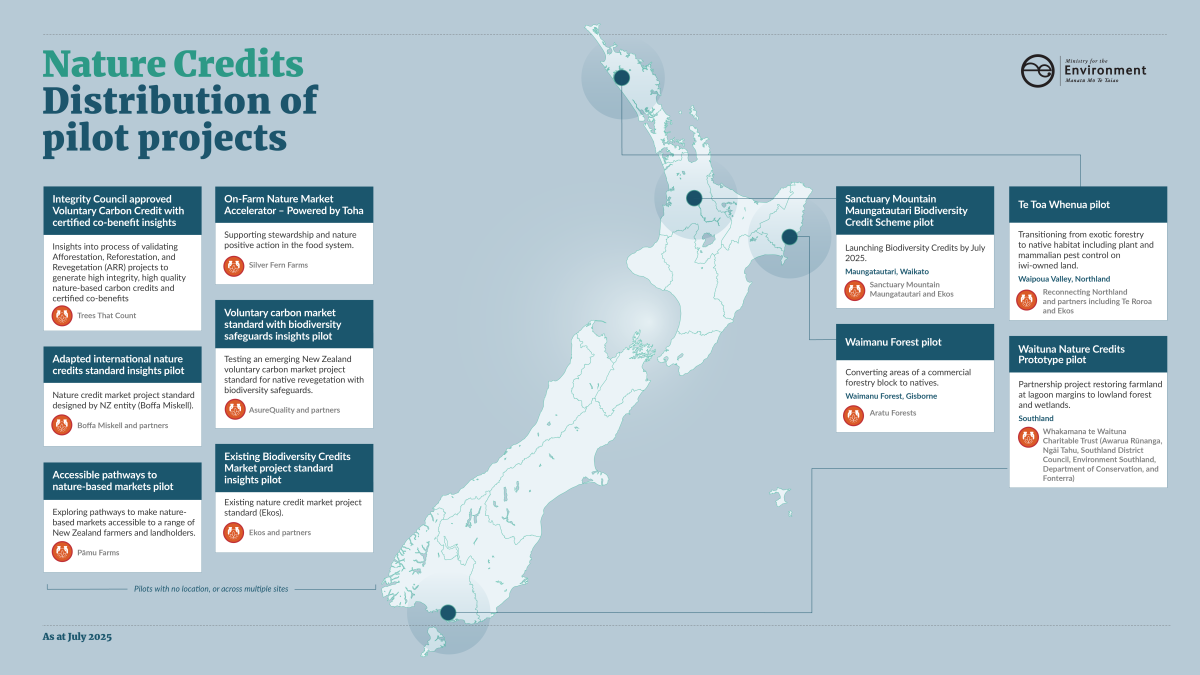
Led by Trees That Count. Offering market insights into the process of validating a portfolio of indigenous afforestation, reforestation and revegetation projects across Aotearoa New Zealand under an Integrity Council for the Voluntary Carbon Market approved international voluntary carbon credit standard to generate verified high-integrity, nature-based carbon credits and certified climate, community and biodiversity co-benefits.
Led by Boffa Miskell. Testing an additional New Zealand biodiversity credits market project standard adapted from United Kingdom methodology for New Zealand environments.
Led by Pāmu Farms. Exploring pathways to make nature-based markets accessible to a range of New Zealand farmers and landholders.
Led by Silver Fern Farms. Testing a processor-led programme for market attraction, and potentially third-party investment, in on-farm nature restoration and enhancement activities that support commercial nature-positive claims.
Led by AsureQuality. Testing a carbon project standard that requires native revegetation and includes biodiversity safeguards, designed to be more applicable and affordable in the New Zealand context.
Led by Ekos. Offering market insights from an existing biodiversity credits market provider, including learning from Reconnecting Northland’s proof-of-concept project.
Led by Sanctuary Mountain Maungatautari. Observing the current process of issuing credits for conservation and protection activities within the inland ecological sanctuary.
Led by Aratu Forests. Converting areas of commercial forestry to native planting for biodiversity uplift and wider social and recreational value, with scope to expand.
Led by Reconnecting Northland. Transitioning land from exotic forestry to native habitat, including planting and pest control on iwi-owned land.
Led by Whakamana te Waituna Charitable Trust and partners. Restoring farmland at lagoon margins to lowland forest and wetlands in a protected site.
The pressures on nature and climate are bigger than the public purse alone can meet.
Businesses and investors in New Zealand and overseas want to support credible environmental outcomes, but until now New Zealand has not had a clear and trusted way to connect that demand with local projects.
That has meant some investment has gone offshore. Smaller farm-scale and community projects have also found it harder to participate.
A more trusted market can help unlock more private investment into restoration and carbon removal here in New Zealand.
It can also help create more opportunities for landowners, iwi, Māori, community groups and project developers to participate in high-integrity projects.
This document provides guidance for participants in voluntary carbon markets.
Recognition of qualifying international accreditation bodies takes effect immediately.
The domestic endorsement process will be operational within six months, once detailed criteria and assurance arrangements are finalised and tested.
Applications for projects on public conservation land will open later this year.
The Government will continue to monitor market development and integrity over time.
Contact the Ministry for the Environment to learn more about growing voluntary nature and carbon markets in New Zealand.