Our journey towards net zero New Zealand's second emissions reduction plan 2026–30: Amended January 2026

New Zealand’s second emissions reduction plan (ERP2) creates opportunities that will help us maintain our way of life, while minimising the cost to our country of mitigating climate change. It is guided by feedback from New Zealanders and anchored by the five pillars of our climate strategy.
The plan was first published in December 2024 and amended in January 2026. The amended ERP2 should be read alongside the January 2026 amendment addendum, which sets out how the amended ERP2 will meet the second emissions budget in light of the revised approach to reducing agricultural emissions.
These documents can be read in conjunction with the ERP2 technical annex (that provides the modelling quantification that informed the plan), and the latest greenhouse gas emissions projections. See the related publications section at the bottom of this page to access the technical annex and the January 2026 amendment addendum.
New Zealand’s second emissions reduction plan (ERP2) creates opportunities that will help us maintain our way of life, while minimising the cost to our country of mitigating climate change. It is guided by feedback from New Zealanders and anchored by the five pillars of our climate strategy.
The plan was first published in December 2024 and amended in January 2026. The amended ERP2 should be read alongside the January 2026 amendment addendum, which sets out how the amended ERP2 will meet the second emissions budget in light of the revised approach to reducing agricultural emissions.
These documents can be read in conjunction with the ERP2 technical annex (that provides the modelling quantification that informed the plan), and the latest greenhouse gas emissions projections. See the related publications section at the bottom of this page to access the technical annex and the January 2026 amendment addendum.
This section summarises the changes made to the second emissions reduction plan (ERP2) across three documents to reflect the January 2026 amendment. It also explains how to read this document in light of the amendment.
In 2025, the Government revised our approach to reducing agricultural emissions. In particular, we have decided not to proceed with implementing an on-farm agricultural emissions pricing system by 2030. The Government remains committed to a technology-led approach to reducing emissions and will leverage market-led schemes that support farmers to adopt new ways of reducing emissions.
ERP2, originally published in December 2024, has been amended to reflect this revised approach.
The amendment consists of an updated ERP2, to be read alongside a new addendum. These documents can be read in conjunction with the ERP2 technical annex, and latest official greenhouse gas emissions projections. Changes across the three documents are as follows.
This document remains the primary reference document to understand the Government’s policies and strategies to meet the second emissions budget (EB2).
The January 2026 amendment is not a comprehensive revision of ERP2 as published in December 2024. Only those sections and references directly impacted by the revised approach to reducing agricultural emissions have been updated.
The agriculture chapter of this document (chapter 10) has been updated to reflect the amendment.
Other references to agricultural emissions pricing that are embedded within unamended content have not been updated – for example, in the executive summary and chapter 2. Where the amendment has superseded the original text, the information is identified as no longer current in the following way:
<Superseded by January 2026 amendment> [reference to agricultural emissions pricing]
Emissions projections are updated annually. They can vary each year due to changes in inventory methods, assumptions, changes in government policy and economic conditions, and updated information about actual emissions.
All projected emissions and emissions reductions in this document reflect 2024 greenhouse gas emissions projections.
Subtracting agricultural emissions pricing impacts from 2024 projections and modelling throughout this ERP2 document and its technical annex does not give an accurate picture of the amendment’s impact, based on the latest available information. 2025 projections reflect revised assumptions across all sectors and shifts in the baseline, so are not directly comparable with 2024 projections.
The addendum sets out how the amended ERP2 will contribute to meeting New Zealand’s targets and budgets. All projected emissions and emissions reductions in the addendum reflect 2025 projections. For the latest emissions projections, see the Ministry for the Environment’s webpage, New Zealand’s projected greenhouse gas emissions to 2050.
[image src="/assets/publications/climate-change/ERP2/MP-Simon-Watts-2023.jpg" id="23796" width="200" height="200" class="leftAlone ss-htmleditorfield-file image" alt="Hon Simon Watts, Minister of Climate Change."]
New Zealand remains committed to the global goal of limiting warming to 1.5 degrees. Nine years after the Paris Agreement, commitments by the global community have reduced our trajectory from 4 to 2.7 degrees of warming. But there is more work to do.
As the globe continues to warm and sea levels rise, we expect weather events to become more frequent and severe, damaging what we value most – our communities, businesses, homes and the environment.
The Government is committed to addressing these challenges and meeting New Zealand’s climate obligations. This plan reflects our commitment to delivering effective climate policies, allowing our climate and economy to thrive.
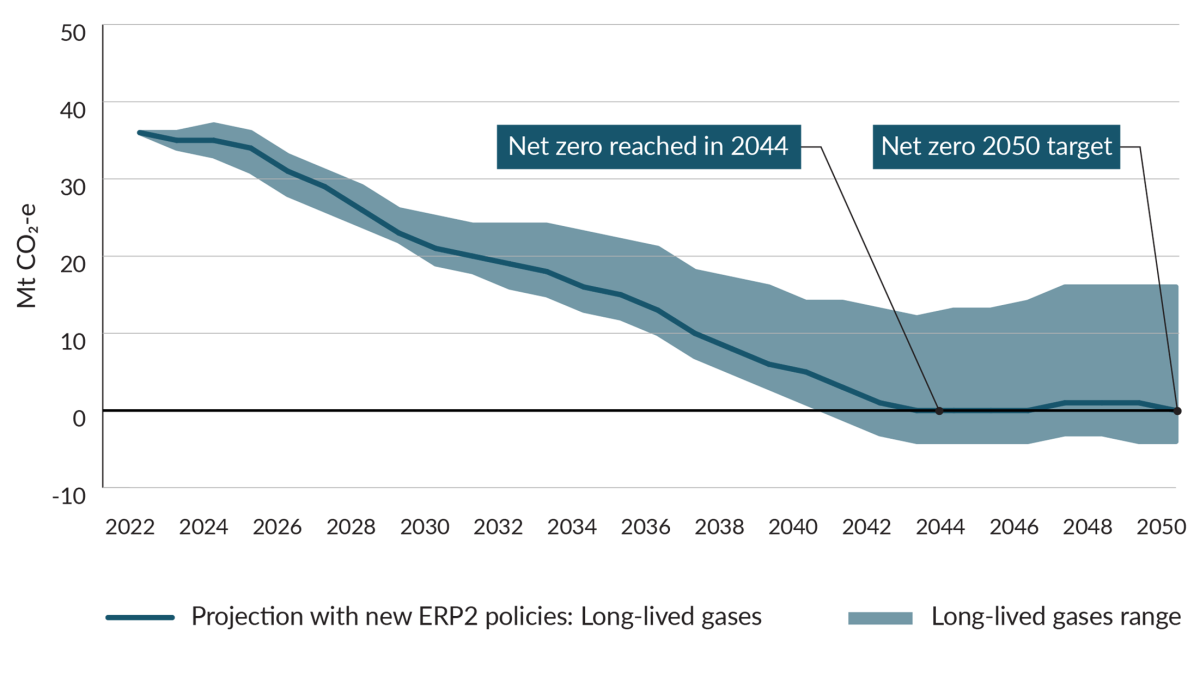
Our plan shows we are on track to meet the first two emissions budgets and the 2050 biogenic methane target. Most importantly, this plan shows that New Zealand is on track to meet our net zero 2050 target, with emissions meeting net zero as early as 2044.
This final plan includes changes based on feedback received during the consultation. It now reflects government policies, such as changes to the New Zealand Emissions Trading Scheme auction settings and private sector actions, like the transition of Huntly Power Station from coal to biomass.
New Zealand stands at a critical point in preparing for a net zero future. Achieving our goals will require collaboration across all groups to reduce emissions, unlock renewable energy, foster innovation, and leverage nature-based solutions.
We are confronting climate change head-on, ensuring a cleaner, more resilient, and prosperous future where our people, economy and environment thrive.
Hon Simon Watts
Minister of Climate Change
All references to projected emissions and emissions reductions in this executive summary reflect 2024 greenhouse gas emissions projections. The latest official emissions projections can be found on the Ministry for the Environment’s webpage, New Zealand’s projected greenhouse gas emissions to 2050.
The Government is committed to delivering on our climate change commitments while growing the New Zealand economy. New Zealand can have prosperous communities, affordable and secure energy, increasing primary production and exports, and a thriving economy while meeting our climate change commitments.
This second emissions reduction plan (ERP2) is the Government’s plan to meet the second emissions budget (EB2) for the period 2026–30. This final plan incorporates feedback and insights from New Zealanders, including the Ministry for the Environment’s youth, climate business, and local government advisory groups, iwi and Māori groups, sector groups, ENGOs, climate scientists and Aotearoa Circle’s Rangatahi Advisory Panel. As a result of that feedback, new sections on technology and innovation, and on building and construction have been added to the plan. We’ve also provided more information about how we’ll monitor our progress and ensure we stay on track.
The first emissions reduction plan ends and ERP2 formally comes into effect on 1 January 2026. However, work on ERP2 initiatives is already underway.
ERP2 confirms that we are on track to meet the first emissions budget (2022–25) and EB2 (2026–30) (figure 0.1).
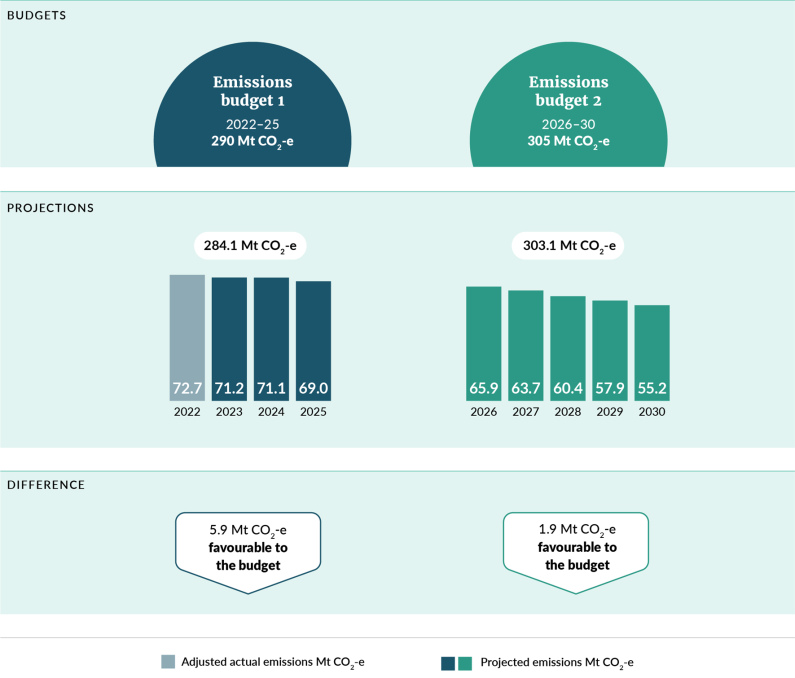
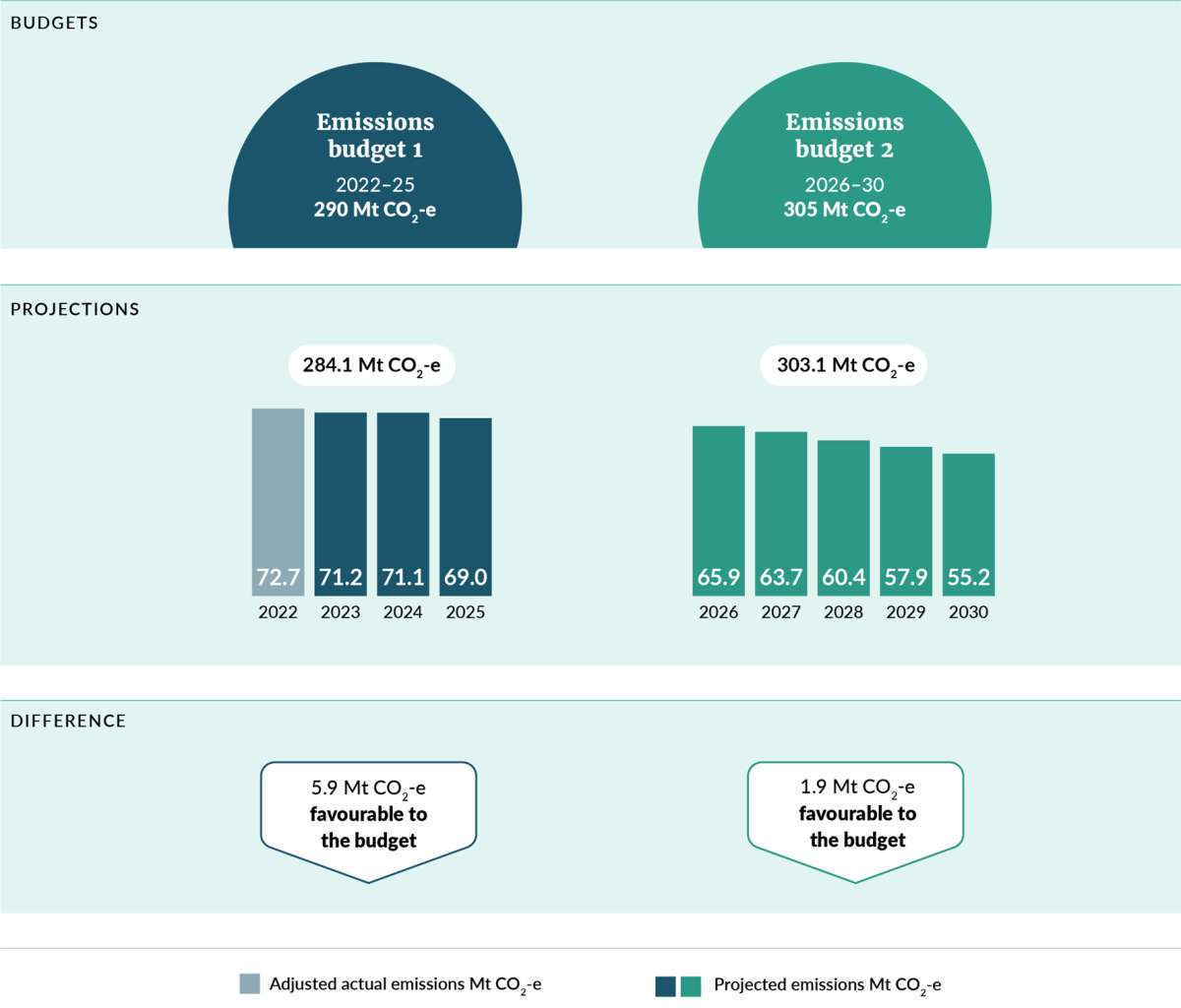
The focus of ERP2 is achieving EB2. Achieving the third emissions budget (EB3) is the task of the third emissions reduction plan, due by 2030. The Government has another five years to develop policies and strategies necessary to deliver EB3.
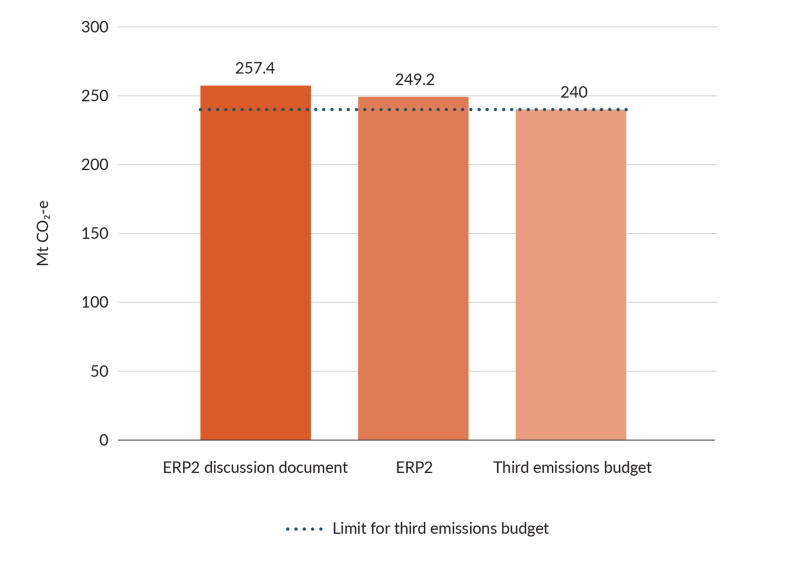
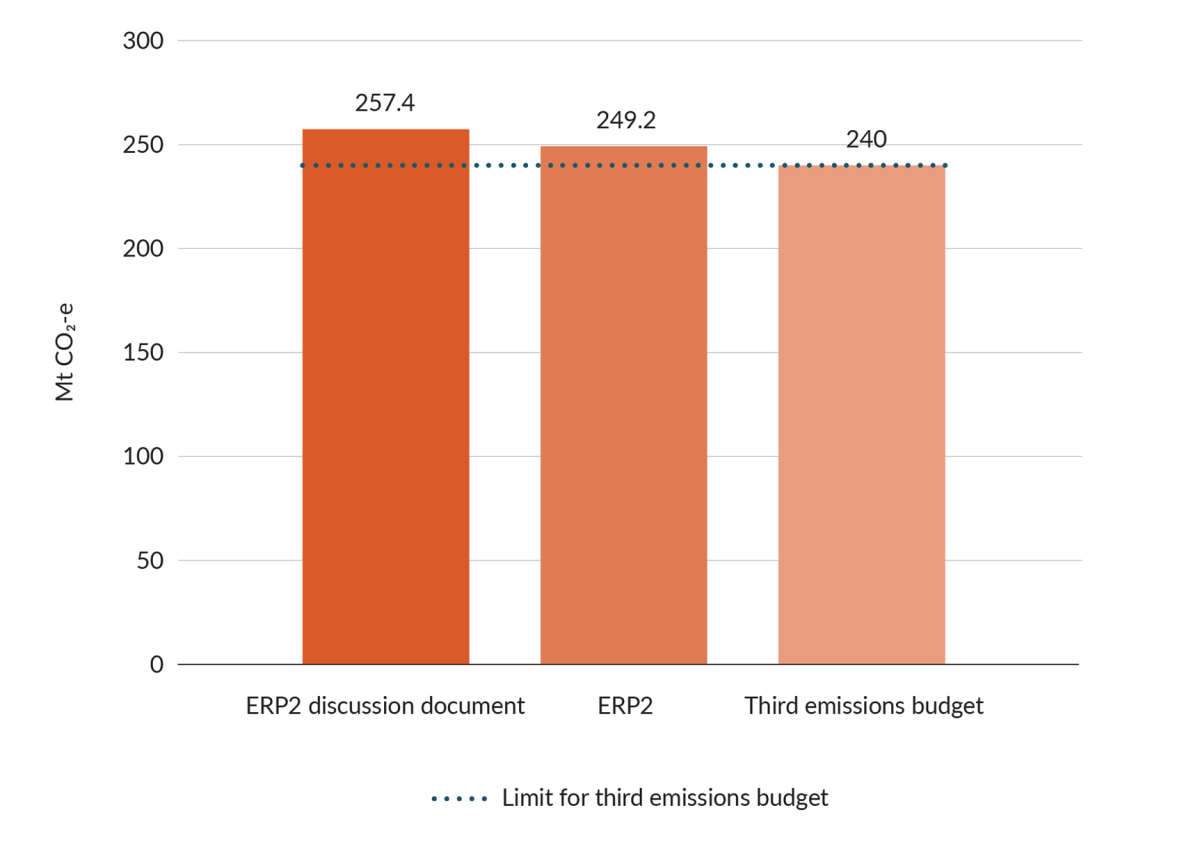
ERP2 delivers significant progress towards EB3 (2031–35). The ERP2 discussion document, published in July 2024, showed projected EB3 emissions as 17 Mt CO2-e1 unfavourable to the budget. This final ERP2 projects EB3 emissions will be 9.2 Mt CO2-e unfavourable to the budget, a significant improvement (figure 0.2).
1 Mt CO2-e = million tonnes of carbon dioxide equivalent.
Emissions budgets are important stepping stones to the long-term target of achieving and sustaining net zero emissions from 2050.
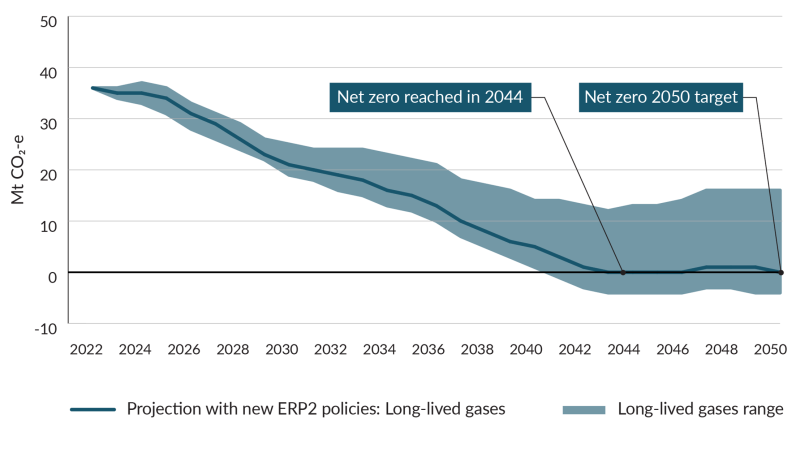
ERP2 projects New Zealand will achieve net zero emissions by 2050 (figure 0.3).
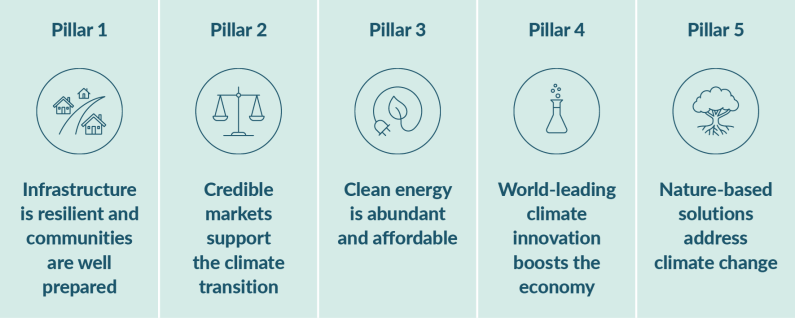
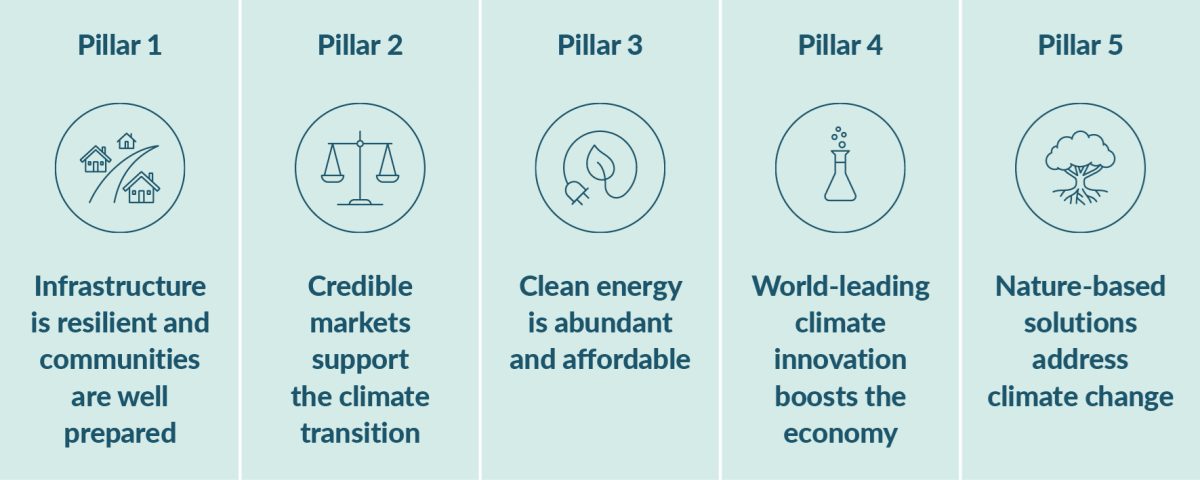
ERP2 is anchored by the five pillars of our Climate Strategy (figure 0.4). The pillars represent our goals for reducing emissions and managing the impacts of climate change.
To achieve our ambitious climate change goals, we need cost-effective action.
ERP2 includes a comprehensive range of policies and initiatives to reduce emissions, accelerate the uptake of new technologies and spur innovation (figure 0.5).

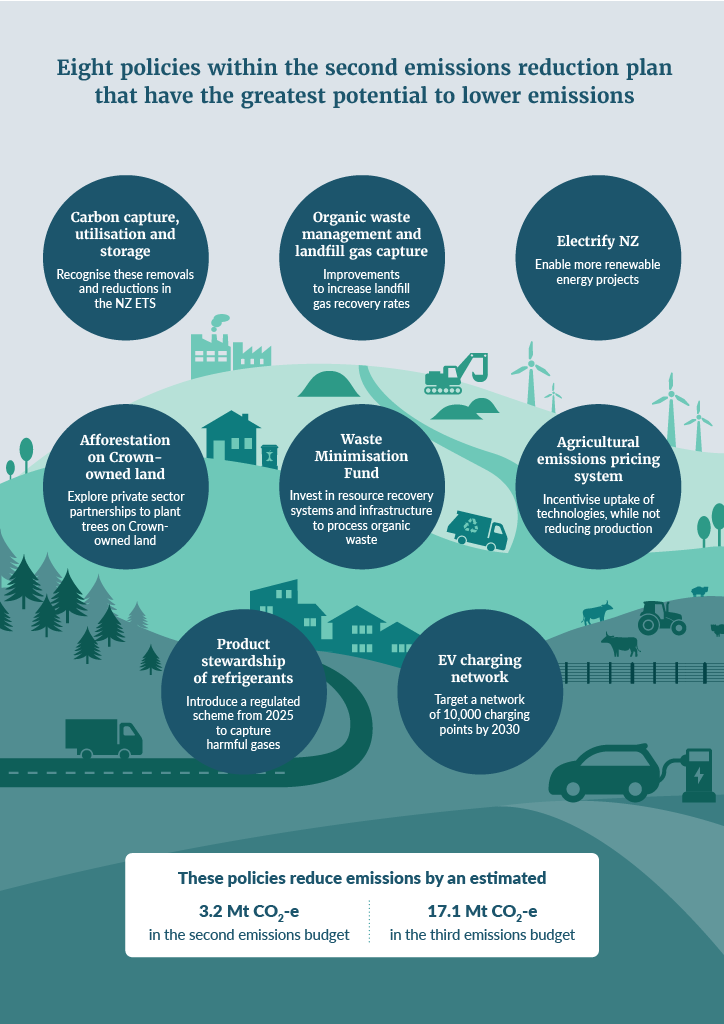
The Government is taking a technology-led approach so the New Zealand economy can grow as net emissions come down. The Government is investing in research and development of new technologies across a range of programmes with the aim of lowering emissions and increasing removals.
Technology can open new pathways to lower emissions. As technologies become commercially available, New Zealand will have more options for achieving emissions budgets and targets.
Promising technologies include:
ERP2 will contribute to our short-, medium- and long-term climate change goals. But securing emissions budgets and targets is only the first step. There is still more work to do. We will monitor progress to stay on track throughout the EB2 period.
In 2025, the Government will:
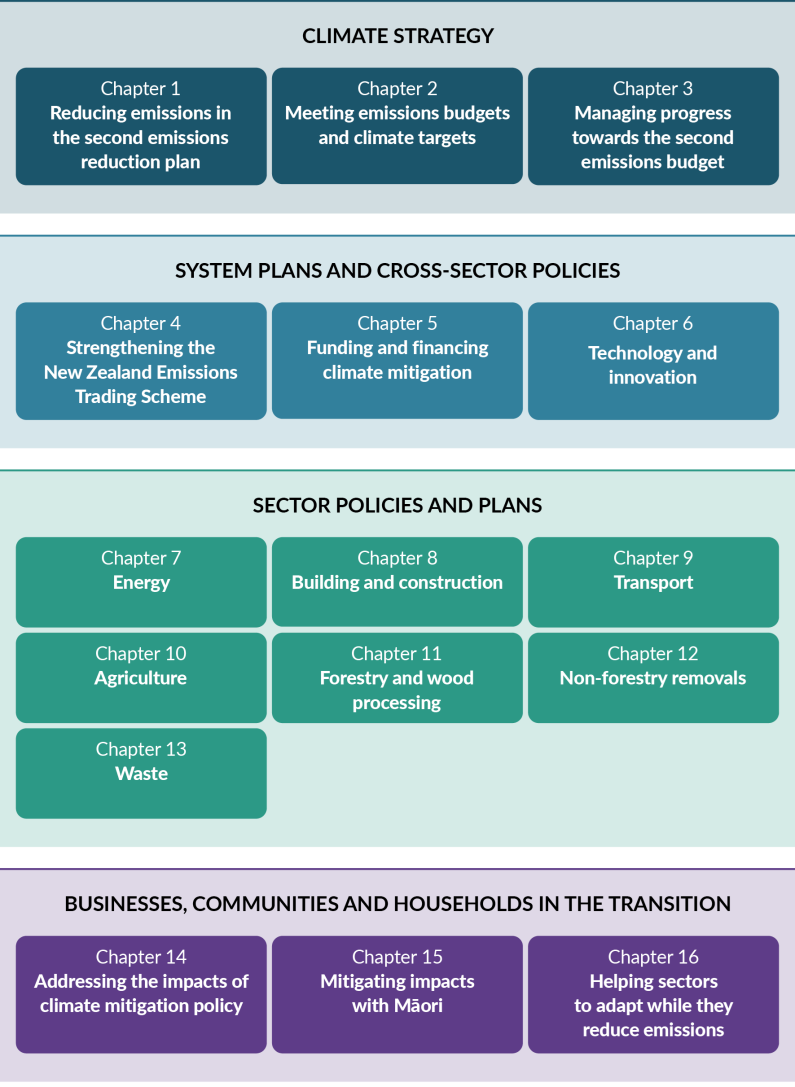

Our journey towards net zero New Zealand's second emissions reduction plan 2026–30: Amended January 2026
January 2026
© Ministry for the Environment