
Dry year a key factor in 2024 emissions
New Zealand’s Greenhouse Gas Inventory shows emissions trends from 1990 to 2024.
New Zealand’s Greenhouse Gas Inventory shows emissions trends from 1990 to 2024.
New Zealand’s greenhouse gas emissions in 2024 decreased by 0.1 percent compared to 2023, despite a dry year driving up emissions in the energy sector.
This represents an 87.3 kt CO₂e, reduction in gross emissions compared to the previous year, which is about the same as taking around 50,000 of New Zealand’s cars off the road.
New Zealand’s Greenhouse Gas Inventory (1990 – 2024) shows gross emissions (total emissions other than forestry and other land uses) were 75,811.6 kilotonnes carbon dioxide equivalent (kt CO₂e) in 2024.
Forests and other land uses absorbed 27.7 percent of gross emissions in 2024, meaning New Zealand’s net emissions dropped to 54,834.1 kt CO₂e in 2024, a 2.0 percent decrease compared with 2023.
The Inventory is the official report of all the emissions produced and removed by human activities within New Zealand, and is compiled every year by the Ministry for the Environment.
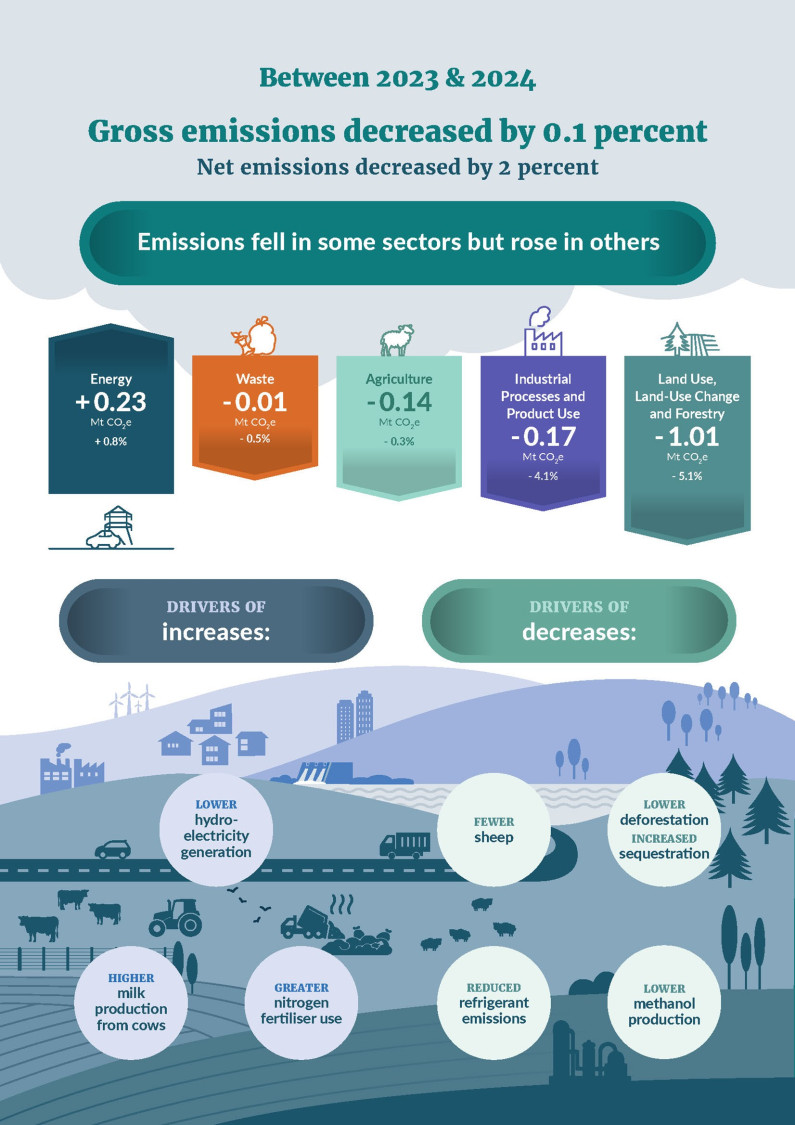
The biggest increase in emissions in 2024 came from electricity generation. 2024 was a relatively dry year, meaning there was decreased generation from hydroelectricity, and more electricity was generated from non-renewable sources to meet demand.
In all other sectors, emissions reduced in 2024 compared to 2023.
The largest decrease in emissions came from the manufacturing and construction sectors. Because more fuel was being used for electricity generation, some manufacturing slowed or ceased to free up fuel supplies and reduce electricity consumption.
In particular, methanol production decreased, resulting in lower emissions from fuel use for manufacturing.
The Inventory records historical emissions back to 1990. Between 1990 and 2006, New Zealand’s emissions climbed. Gross emissions peaked in 2006 and were relatively stable through to 2019. Since 2019, emissions have generally been in decline, with an increase between 2020 and 2021 due to rebounds following the COVID-19 pandemic.
The Inventory covers historical emissions. Other reports provide progress towards emissions reduction targets. Projections updated in January 2026 show how we are tracking towards both international and domestic targets. These projections will be updated in the second half of 2026.
New Zealand’s Greenhouse Gas Inventory is compiled and submitted as part of our responsibilities under the Paris Agreement and the United Nations Framework Convention on Climate Change.
Accurate measurements and reporting of our emissions are also critical to inform New Zealand’s climate change decisions.
For more about the Inventory see: New Zealand's Greenhouse Gas Inventory | Ministry for the Environment