Background
In November 2006, Cabinet invited the Minister for the Environment to prepare a discussion document and a draft cost−benefit analysis on two national environmental standards (NES) for electricity transmission under the Resource Management Act 1991 (RMA). The proposed standards aimed to:
- provide a consistent national framework for managing the effects of transmission activities (covering operation, maintenance and upgrading of the national grid), referred to as the transmission activities NES
- protect transmission lines from inappropriate activities that could put the integrity of the national grid at risk, referred to as the transmission risks NES.
The proposed standards
The transmission activities NES covers the operation, maintenance and upgrading of transmission lines, but does not cover substations or the construction of new lines. The proposed NES presents a framework for managing the adverse effects of transmission activities. It lists those activities that do not have significant adverse environmental effects as permitted activities – where resource consent would not be needed – along with terms and conditions designed to restrict the adverse effects of these activities. The proposed NES then sets out consent categories for activities that require resource consent. This proposed NES would only apply to the line owner and contractors carrying out work on behalf of the line owner.
The transmission risks NES provides controls on activities adjacent to transmission lines that could have adverse effects on the transmission infrastructure and could put the transmission network at risk. This proposed NES would only apply to third parties and would not apply to the line owner or contractors carrying out transmission activities on behalf of the line owner. The proposals prohibit high-risk activities and set out resource consent requirements for excavation, depositing material, buildings, subdivision and boat ramps under or adjacent to transmission lines. The proposals contained two options for controls on buildings:
-
Option A, based on the New Zealand Electrical Code of Practice for Electrical Safe Distances (NZECP 34), which provides for risk zones around the conductors and support structures
-
Option B, which proposes a 20-metre zone within which resource consent would be required.
Both proposed standards would apply to the high-voltage electricity transmission network, including line supports and conductors.
Feedback on the proposed standards
A discussion document setting out details of the proposed standards was released for public comment on 12 October 2007, and public notices of the submission period were placed in major newspapers on the same day. A copy of the public notice is included in Appendix 1 of this report. In brief, the notices informed people of:
-
the subject matter of the proposed standards
-
the Minister’s reasons for considering that the proposals are consistent with the purposes of the RMA
-
how people could make a submission
-
the deadline for submissions.
During the submission period four public workshops were held: in Auckland, Hamilton, Christchurch and Wellington. In addition, the Ministry for the Environment’s Talk Environment Roadshow travelled throughout New Zealand between 17 October and 2 November 2007. The Ministry visited 17 centres and facilitated 31 meetings with local government and the public. The meetings were attended by approximately 1,500 people, all of whom had access to a fact sheet that included information about consultation on the proposed national environmental standards. The submission period closed on 30 November 2007.
Purpose of this document
This document presents an overview of the submissions received on the two proposed NES for electricity transmission. Eighty-four submissions were received (see Appendix 2 for a list of submitters). The discussion document posed 16 questions for discussion (see Appendix 3). Submitters also raised additional issues, such as the need for guidance on implementing the standards.
This report is intended to provide a concise summary of the views expressed. It is not intended to analyse those views or make recommendations in response to the submissions, as this will be done in a separate report.
NES development process
An outline of the national environmental standards development process, including the informal and formal submission stages, is shown in Figure 1. The Ministry has completed the public process stage and the release of this report on submissions marks the end of the submission stage.
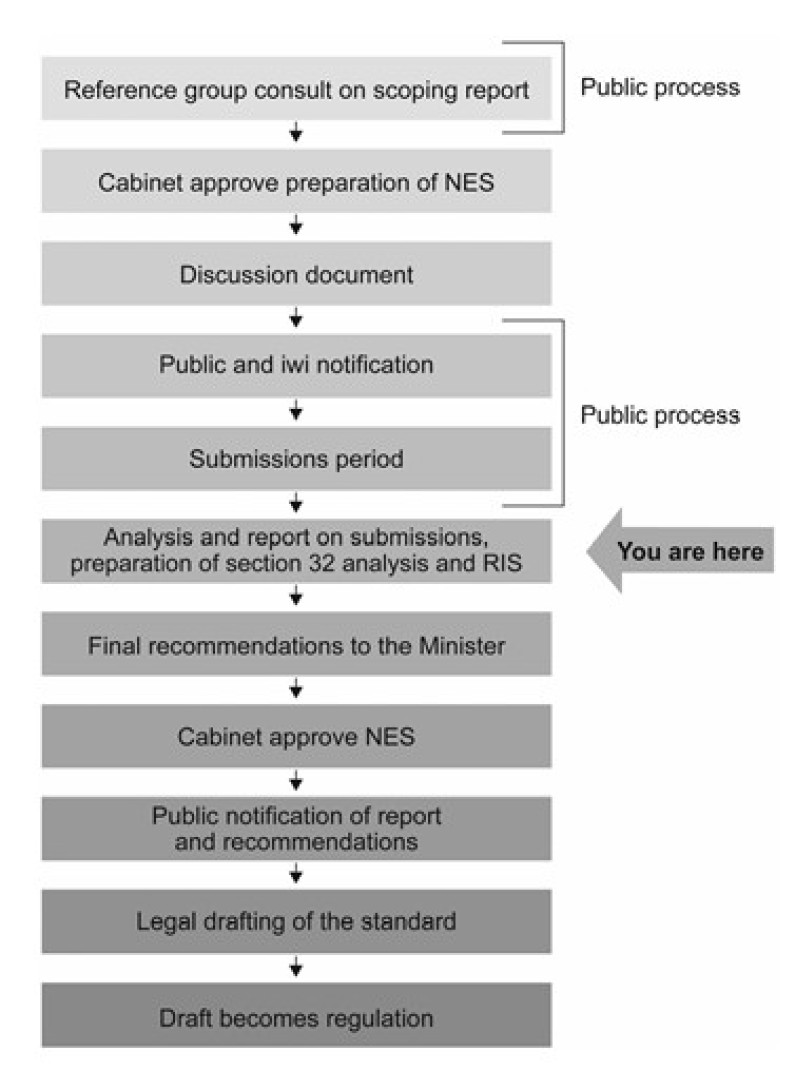
Breakdown of submissions, by type of submitter
A total of 84 submissions were received. Table 1 gives a breakdown of the submissions by category of submitter.
Table 1: Number of submissions, by category of submitter
| Category | Number of submissions (%)* |
|---|---|
| Landowners | 24 (29%) |
| Territorial authorities | 16 (19%) |
| Individuals | 9 (11%) |
| Electricity industry | 9 (11%) |
| Non-governmental organisations (NGOs) | 9 (11%) |
| Regional councils | 8 (10%) |
| Government | 3 (4%) |
| Other industry | 3 (4%) |
| Unitary authorities | 2 (2%) |
| Iwi authorities | 1 (1%) |
| Total | 84 |
Note: For the purposes of this report the corresponding percentages (in brackets) have been rounded up to whole numbers, and so do not sum to 100.
Figure 2: Proportion of submissions, by category of submitter
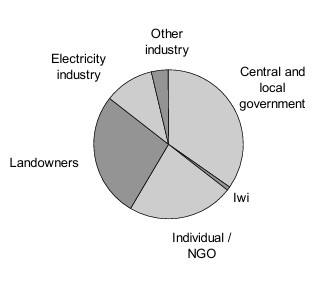
Twenty-six submissions were received from local government (territorial authorities, regional councils and unitary authorities). Twenty-four submissions were received from landowners, accounting for 29 percent of the submissions. Individual submitters and non-governmental organisations (NGOs) provided nine submissions each. Nine submissions were also received from the electricity industry, three from other industry and one from an iwi authority.
Breakdown of submissions, by position
The majority of submitters supported, in principle, the concept of providing consistent requirements for electricity transmission. However, they differed in their views on the appropriate way to provide for electricity transmission, ranging from full support for the standards as proposed, to opposition and a preference for a different method of providing for electricity transmission.
Submissions were grouped into five categories, according to their position on the proposal:
-
support − clear support was indicated for the proposed standards, including submitters giving support but requesting a small number of minor changes to improve the clarity of the proposals, such as requesting the consistent use of terms or making reference to regional plans and policy statements as well as district plans
-
conditional support − clear support was indicated for the proposal, but requesting more than minor changes, such as re-classifying activities
-
not stated − no clear statement of support or opposition was given, and this could not be determined from the content of the submission
-
conditional oppose − indicating opposition to the standards as proposed, but that such opposition could be overcome by making specific changes to the proposals
-
oppose − indicating clear opposition to the standards as proposed, and requesting that either the standards be completely redrafted or that another solution would be preferable.
Figure 3 shows the breakdown of submissions, by position on the proposal, for each of the proposed standards.
Figure 3: Proportion of submission, by position, for each of the proposed standards
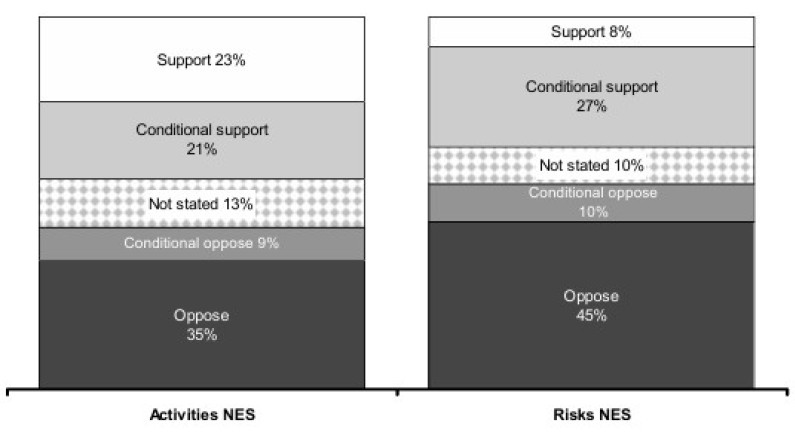
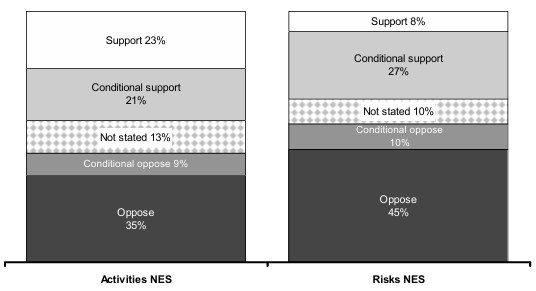
The breakdown of submissions by position for the proposed transmission activities NES shows that 44 percent of submitters supported the changes, either as proposed (23 percent) or subject to specific changes being made (21 percent). Thirty-five percent of submitters opposed the NES, and a further 9 percent opposed the standards but their objections would be met by making specific changes.
For the proposed transmission risks NES, 45 percent of submitters opposed the NES, and a further 10 percent opposed the NES but their objections would be met by making specific changes. Only 8 percent of submitters supported the proposed NES without change, and another 27 percent supported it but asked for significant changes.
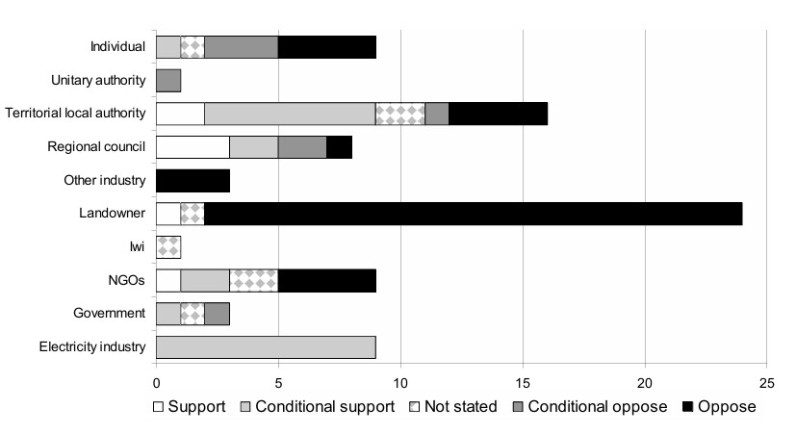
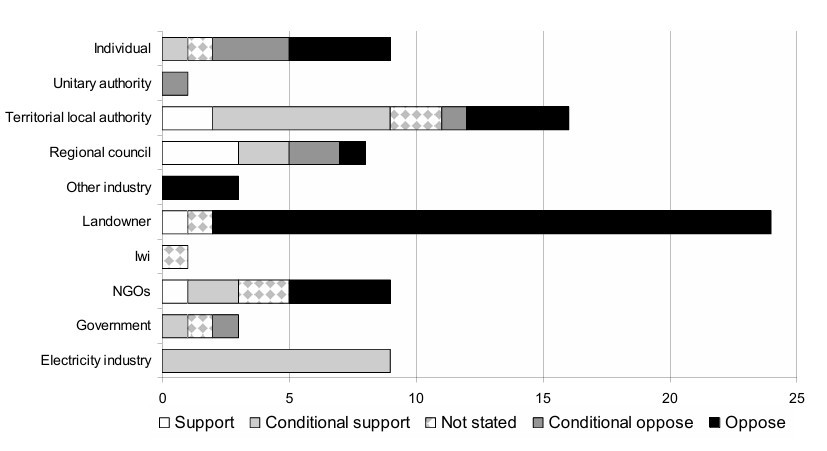
The breakdown of submissions by both position and submitter group is depicted in Figures 4 and 5. These figures clearly show that the majority of landowner submissions were opposed to both the proposed transmission activities NES and the proposed transmission risks NES. Individuals and NGOs expressed a range of views about the standards, while the majority of local government submissions indicated support or conditional support for the standards. Although only one local government submitter was opposed to the proposed transmission activities NES, five were opposed to the proposed transmission risks NES. The electricity industry expressed support for the proposed transmission activities NES and conditional support for the proposed transmission risks NES.
Figure 4: Breakdown of submission on the transmission activities NES, by position and submitter category
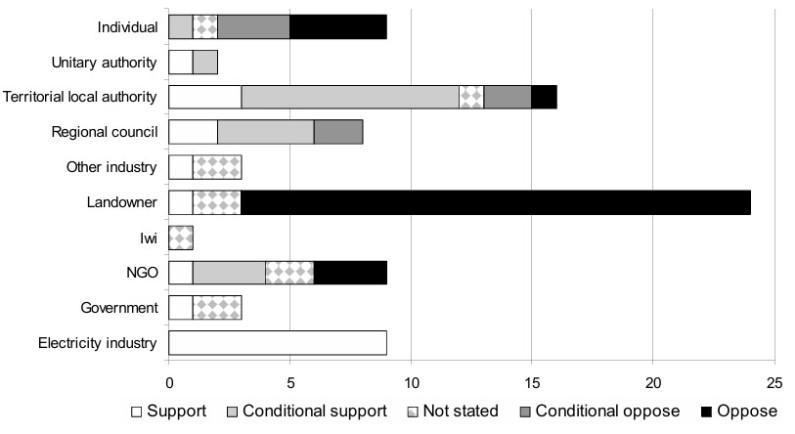
Figure 5: Breakdown of submissions on the transmission risks NES, by position and submitter category
Key themes
Table 2 sets out the key themes that arose in the submissions, based on the questions posed in the discussion document and further themes identified during the analysis of submissions.
| General theme | Question no | Sub-theme |
|---|---|---|
| Applicability of the standards |
Q 1
Q 3 |
Appropriateness of the standards Objective of the standards and its relationship to the purpose of the RMA Alternative options |
| Scope of the standards | Q 10 | Construction of new transmission lines Other high-voltage electricity networks Proposed definitions |
| Transmission activities NES |
Q 5
Q 6
Q 7
Q 8 |
Permitted activities:
Controlled and restricted discretionary activities Provision for “non-complying” activities Other transmission activities |
| Transmission risks NES |
Q 11
Q 12 Q 14 Q 13
|
Appropriateness of the proposed transmission risks NES Activity types Other activities Building options:
|
| Cost−benefit appraisal | Q 15, Q 16 |
range and accuracy of cost−benefit analysis:
|
| Electricity Act and land ownership issues |
Electricity Act issues Effect on landowners |
|
| Electric and magnetic fields | ||
| Implementation issues | Implementation process Guidance |
|
| Process and consultation | ||
| Links with the national policy statement on electricity transmission |
||
| Decision requested |
Applicability of the standards
The issue of whether the standards are the most effective tool for managing national electricity grid issues in New Zealand was split into three parts:
- the appropriateness of the standards
- the objective of the standards and its relationship to the purpose of the RMA
- alternative options.
Appropriateness of the standards
The discussion question about whether the proposed standards are the most appropriate way of providing detailed national direction for managing the national electricity grid (Question 1) was addressed in 46 submissions. Twenty showed overall support for using the standards to address electricity transmission issues.
Six responses supporting the proposed standards were received from electricity industry submitters, with three saying that the standards will provide a consistent national framework for managing the environmental effects of the operation, maintenance and upgrade of the national grid. One submitter also mentioned a possible reduction in environmental compliance costs and increased certainty to grid planners when planning transmission line maintenance and upgrades, and four suggested that other high-voltage electricity networks should also be covered by the proposed standards.
Five responses supporting the appropriateness of the proposed standards were received from territorial authorities (city and district councils), with two acknowledging that the proposed NES is the most appropriate tool to address inconsistencies in plans and provide for greater certainty for the line owner and councils. There were some qualifications, however. One submitter emphasised the need for the proposed standards to be combined with a strong and balanced national policy statement (NPS) on electricity transmission, and one territorial authority acknowledged the value of having standards but remained unconvinced as to the appropriateness of the NES as proposed.
Four responses in support of the appropriateness of the standards were received from individuals and NGOs. One described the proposed standards as being fundamental to achieving the electricity outcomes specified in the New Zealand Energy Strategy, and one believed that the proposed standards could fill the gap in the current provisions for electricity transmission operation, maintenance and upgrading and increase certainty and security of electricity supply. One suggested that the proposed NES should provide a standardised framework consistent throughout all districts, while another submitter agreed with the proposed standards in principle but suggested that designation would be a better option.
Twenty-six submitters questioned or opposed the appropriateness of the proposed standards. Seventeen responses were received from landowners, with 11 claiming that the proposed standards would allow for the transmission line owner to “circumvent the obligations placed on all activities by section 5(2)c of the RMA” to avoid, remedy and mitigate adverse effects on the environment. One claimed the standards were poorly drafted and did not encourage considering other alternatives to transmission upgrades. Another submission noted that the standards as proposed are entirely one-sided, but admitted that an NES might be appropriate once easements and other land access issues are resolved. The suggestion was made that a combination of the NZECP 34 rules, easement agreements and normal planning process would be the most appropriate way of addressing grid management issues. Another submitter questioned whether the standards constitute sustainable management and suggested that subsidised electricity generation closer to the point of use would be a more sustainable option.
Three responses questioning the appropriateness of the proposed standards were received from territorial authorities, with one claiming that insufficient regard was given to the impacts of transmission lines on third parties, one saying that the standards as proposed do not evaluate competing objectives, and one noting that the national policy statement on electricity transmission should be sufficient to guide local authorities down a “national perspective path”.
Three responses received from individuals and NGOs argued that the proposed standards are not the most appropriate tools for electricity grid management. One submitter suggested that the standards are an attempt to transfer powers to Transpower, allowing it to control the area around the grid, which should be covered by a properly negotiated easement agreement. One submitter opposed the standards on the grounds of restricting landowners’ property rights, and one suggested the standards would need to include environmental outcomes, amenity values and compensation for landowners in order to be appropriate.
The objective of the standards and the purpose of the RMA
A total of 42 comments were received on this subject (Question 2), and they can be divided into two main groups.
Ten submitters agreed with both the objective of the proposed standards and its ability to meet the wider sustainable management purpose set out in the RMA. The proposed standards were generally acknowledged to achieve the objective of sustainable management of the national grid as a physical resource, adequately address relevant environmental issues and complement the NPS. In addition, seven submitters agreed with the objective of the standards as proposed, subject to various amendments. Widening the objective, increasing clarity and adequacy, providing interpretation and guidance, and taking land use into account were among the issues raised.
The second group includes submitters who disagree with the objective of the proposed standards and do not believe it meets the purpose of the RMA. Twenty-three submissions expressed this view, the majority from landowners (16 submissions, including 11 that were substantially identical). The predominant argument against the objective of the proposed standards and its consistency with the RMA was that it overstated the importance of electricity transmission infrastructure in comparison with the assets of other network utility companies, which could also claim national significance and request similar treatment under the RMA. Many submitters opposed promoting the national significance of electricity transmission above other land uses − which also have to be sustainable.
Two territorial authorities remained unconvinced about whether the objective aligns with the RMA purpose, and believed further assessment is needed.
Other comments included that the scope of the proposed NES is too narrow because the objective focuses on the sustainable management of the grid only from the operator’s perspective, and only addresses national and business interests.
Alternative options
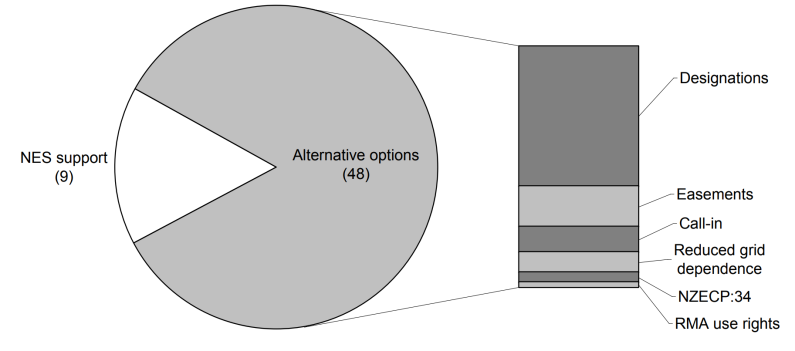
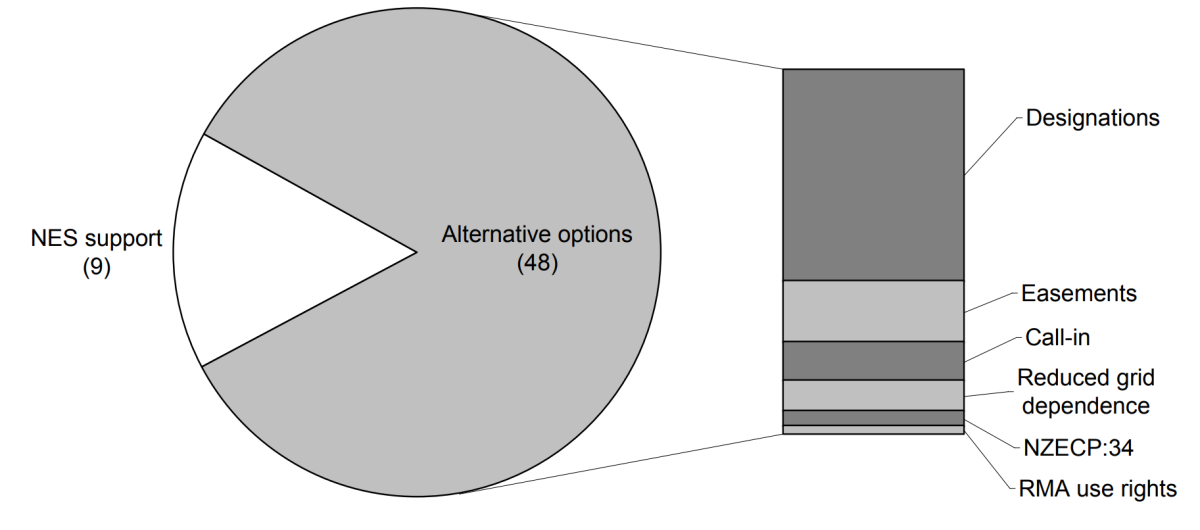
The issue of analysing and presenting options for providing detailed national guidance under the RMA for the sustainable management of electricity transmission (Question 3) was addressed in 42 submissions.
The majority of submitters thought that alternative options were not given enough consideration and should have been explored to a greater level of detail. A number of respondents suggested implementing alternative solutions, including:
-
designations (28 submissions)
-
easements negotiated with landowners (eight)
-
Minister’s call-in (five)
-
risk management under the NZECP 34 (two)
-
clarification of existing-use rights provisions under the RMA (one)
-
promoting distributed generation and demand management to reduce reliance on the grid (four).
Figure 6 summarises submitters’ views on the most appropriate electricity management option and shows a breakdown of alternative solutions suggested by respondents.
Figure 6: Submitters’ views on the most appropriate grid management option
Twenty-eight submitters said that alternative options were not given enough consideration and that the entire analysis was heavily weighted towards Transpower, with insufficient consideration given to sustainable management of the environment.
Submitters noted that the RMA enables Transpower, as a requiring authority, to arrange for designations for existing transmission corridors. While it was acknowledged that this would result in costs to Transpower, this was seen as more appropriate than the proposed standards, which could be construed as a “blanket designation of all existing transmission lines” without providing landowners with any compensation.
Eleven submitters said that no detail was provided on how the $7 billion Transpower estimate for purchasing the land for designations was reached. Submitters commented that this estimate seemed very high and requested a more detailed examination of this issue before a decision was made to proceed with the standards. It was also noted that the analysis did not “extrapolate the $7 billion value down to landowners’ assets”, and suggested that the cost of acquiring the land under the transmission lines represents the amount by which landowners subsidise the transmission network.
Landowners argued that the issues the proposed transmission risks NES is intended to address would be better handled through easements negotiated with landowners. Landowners suggested that easements would give Transpower control over landowner activities adjacent to the transmission network, but allow landowners to be compensated for the restrictions on their activities. It was estimated that the annual cost of easements for Transpower would be around $100 million (although no details were given on how this figure was calculated or whether it applied to all land under the network or only to rural land). One submitter estimated that landowner agreements would cost one-third of a cent per electricity consumer. It was suggested that this alternative should be included in the analysis of options.
Eleven submitters also noted that no consideration was given to the findings of the New Zealand Utilities Advisory Group (NZUAG), formed to investigate legislation governing access to national road corridors as “utility corridors”, as suggested in the Utilities Access Amendment Bill. This concept was acknowledged to be of significant merit, especially in congested urban areas where accumulation of utility services conflict with urban activities, and land use is constrained.
One submitter questioned the effectiveness of local input under the proposed standards, and two noted that the proposed measures simply transfer the costs from Transpower to the landowners rather than promoting any gain in economic efficiency.
Full support for the proposed standards as the “best” option, after a thorough consideration of all existing alternatives, was expressed by nine submitters: four from the electricity industry, three regional councils, one territorial authority and one unitary authority.
Scope of the standards
Comments on the scope of the proposed standards are divided into two parts. The first summarises points of view on whether the standards should cover the construction of new transmission lines, and the second addresses the issue of applying the proposed standards to other high-voltage lines owned by distribution companies.
Construction of new transmission lines
The issue of whether the proposed standards should cover the construction of new transmission lines (Question 10) was addressed in 42 submissions. Thirty-one submitters said that the standards should not cover the construction of new lines. Of these, most were landowners (14 submissions), territorial authorities (10), regional councils (two) and individuals and NGOs (three). One unitary authority and one “other industry” representative also expressed a similar opinion.
Only three submitters explicitly stated that the proposed standards should apply to the construction of new transmission lines. A further two felt the standards should apply to only those new lines (once they are built) that are not covered by a designation. One submitter suggested that the standards should not be considered the only appropriate mandate for establishing new lines. Four submitters found it difficult to comment on the issue due to insufficient information on how the proposed standards might apply to new lines.
A number of alternative mechanisms were proposed to address the construction of new transmission lines, including negotiation with landowners and the use of designations (seven submissions).
Transpower expressed general support for the maintenance and upgrade of new transmission lines (after they are built) to be included in the proposed standards, provided they only apply to lines that are authorised by resource consent but not those established by way of a designation. According to Transpower’s submission, such a course of action is not possible under the RMA as it stands. Transpower supports applying the proposed standards only to existing assets at the time the regulation commences and suggests introducing amendments to the RMA to clarify the relationship between the standards and future designations.
Other high-voltage electricity networks
Seven submissions suggested that the scope of the proposed NES should be extended to high-voltage lines owned by generation and/or distribution companies. Four electricity industry submitters and one NGO stated that applying the proposed standard to assets other than those owned by Transpower would enhance the viability of renewable energy projects, which are promoted in the New Zealand Energy Strategy and in section 7 of the RMA. One submitter proposed that the standards should include both the generation and distribution of electricity, and another proposed that they should apply to all high-voltage lines.
Proposed definitions
Several submitters made editorial comments and suggestions on ways of improving the clarity of the definitions provided in the discussion document. For example, Transpower proposed that small structures such as swimming pools, sheds and garages be included in the definition of “buildings”, and that no distinction be made between occupied and unoccupied buildings, as this issue should be considered at the resource consent stage.
Transmission activities NES
Permitted activities
Twenty-five responses were received on whether more transmission activities should be permitted than are currently proposed in the transmission activities NES (Question 5). Nine submitters (four local authorities, three landowners and two individuals) thought no more activities should be permitted by the NES, and two individuals claimed that too many activities are already classified as permitted. Three submitters said there was no justification for a number of activities to be subject to more lenient measures than at present, and one noted that the proposed NES would lock in the effects of existing lines and encourage upgrading in preference to constructing new (and perhaps more appropriate) lines.
One submitter from the electricity industry proposed that all existing plans be taken into consideration, and that if any of the activities are permitted in the majority of local plans then those activities should be permitted. The rationale given for this is that local authorities have accumulated experience in dealing with such activities over time. Another electricity industry submission suggested that if there are any activities that do not have significant adverse effects, they should be put forward to be considered as permitted at this stage of the process.
One of the NGOs and one electricity industry submitter suggested that the proposed NES needs to specify that transmission activities as such are permitted, because defining specific components as permitted runs the risk that some minor activities may be overlooked and therefore default to discretionary. It was also suggested that the NES should include a catch-all statement that “all transmission activities are permitted” and that “the terms and conditions apply to specific aspects”.
Transpower and one other submitter noted that a number of activities are currently not listed as permitted (or controlled, restricted discretionary) and therefore would default to discretionary. Because these minor activities are currently permitted in most districts as “operation, maintenance and minor upgrading”, they should be permitted in the NES. The list could be expanded to ensure complete coverage, or the NES could specify that all “operation, maintenance and minor upgrading is permitted, provided that terms and conditions are met, and that the activity is not listed in another category”. Such activities include inspection of a line, switching circuits on and off, varying currents and removing birds’ nests.
Three submitters proposed that the undergrounding of transmission lines be included in the permitted activities category, and one individual felt that height decreases of poles and towers should also be permitted.
Two submitters expressed concern at the proposal to allow voltage increases as a permitted activity, arguing that due to potential site-specific health and environmental effects, voltage increases beyond the original design capacity should be subject to resource consents.
Three submitters noted that any activities that cannot be authorised under section 23(3) of the Electricity Act should not be scheduled, to avoid councils being involved in property rights conflicts. The same rule was said to apply to any activities that compromise landowner rights. Several submitters noted that activities that result in an increase in the land or air space occupied by transmission lines constitute “encroachment” and should not be permitted. Submitters quoted the 2007 Environment Court decision on Fernwood Dairies1 application for compensation under the Electricity Act in support of their argument.
1 Fernwood Dairies Ltd vs. Transpower, Environment Court Decision (15.12.06); Environment Court decision number C 171/2006.
Terms and conditions
Thirty-one submitters commented on the appropriateness of the terms and conditions for permitted activities (Question 7), and the matters that councils could take into account when considering applications for controlled and restricted discretionary consent applications. Ten of these submitters provided detailed comments on the specific proposals that were listed in the appendices to the discussion document.
In general, submitters were concerned that the terms and conditions be expressed clearly to ensure that activities listed as permitted did not have significant adverse effects on the environment. One felt that many of the standards are poorly drafted, that it is not clear what activities they apply to, and that it is difficult to identify the cascade of standards. Other specific issues raised and suggestions made by submitters included:
-
the proposed NES does not address cumulative impacts
-
ensure that height increases and relocations are only allowed once (in relation to a baseline height and location), and that line supports cannot be moved closer to buildings (see further discussion below)
-
ensure that certain activities are not permitted in locations where they may affect landscape and amenity values, and that references to special areas include regional plans and regional policy statements as well as district plans
-
ensure that effects on historic heritage are minimised (and use commonly accepted terminology), and that there is wider recognition of recorded sites (eg, via the New Zealand Archaeological Association register)
-
consider whether earthworks conditions should be customised for specific plans around the country
-
address “non-operational” activities through existing regional and district plans
-
do not default to plans, otherwise the NES will not provide national consistency
-
ensure that all effects are covered, so that local authorities do not resort to covering additional effects in inconsistent ways in permitted rules in their plans
-
restrict the ability of councils to set terms and conditions for activities permitted by the NES
-
terms and conditions should be aligned as closely as possible to plan requirements
-
consider requiring Transpower to notify councils of work being undertaken under permitted activity status
-
add “earth potential rise hazard” to matters to be considered for activities that could create or worsen this hazard.
Resource consent requirements
Twenty-two responses were received on the question about whether the proposals for permitted activities are likely to generate additional resource consent requirements (Question 4).
Ten submitters (four individuals and NGOs, two regional councils, two submitters from the electricity industry, one territorial authority and one landowner) thought that introducing the standards would lead to an increased number of resource consent applications. Regional councils said the reasons for additional consent requirements would be not providing for permitted activities in beds of lakes and rivers and the coastal marine area, as well as the specific condition on the volume and extent of earthworks. One regional council submitted that some activities (namely those in the beds of lakes and rivers, coastal activities and discharges to air and water) will be subject to more stringent consent requirements, leading to additional resource consent applications; whereas in other areas, such as activities related to discharges to air, consent requirements would be less stringent and the number of applications will decrease.
Submitters from the electricity industry noted that resource consents might be required where there are discharges of contaminants, earthworks and changes to the landscape at specific sites, as well as for matters such as:
-
adding circuits
-
removing existing lines
-
(in some instances) matters relating to conductors
-
adding earth wires and aerial communication cables
-
vegetation trimming or removal for maintenance.
Four submitters thought that additional resource consents were unlikely because the standards are permissive enough, with one territorial authority suggesting that consent should be required for thermal upgrading of the lines, alterations and replacement of wires, and to cover remediation of areas where lines were removed. One electricity industry respondent argued that the proposed standards would ideally be made applicable to a wide range of activities relating to electricity transmission. One unitary authority said that the proposal for permitted activities was broadly similar to its resource management plan.
Two submitters remained uncertain about the effect on resource consent requirements of introducing the proposed standards. One territorial authority sought further clarification on the requirements − whether they should be in place and whether up-skilling of local government staff would be needed.
Five submitters (two territorial authorities, two individuals and one landowner) sought clarification on the extent of existing-use rights, and one territorial authority requested an explanation of whether Transpower would be required to obtain a Certificate of Compliance for activities proposed as permitted.
Transpower suggested that the transmission risks NES needs to clarify the process of bundling consent requirements. The prevailing approach is that where one proposal requires consents under a range of resource consent categories, the whole project is to be considered under the strictest category. Transpower argued that such an approach is inconsistent with the purpose of the standards and suggested that the concept of bundling be specifically addressed and clarified in the regulation.
Coastal marine area and beds of lakes and rivers
Transpower expressed concern that the proposed standard does not provide for any activities in the coastal marine area (CMA) or in/over the beds of rivers or lakes, and argued that sections 12, 13 and 14 of the RMA do not make any provision for an NES to establish these activities as permitted on a nationwide basis. Transpower proposed that making these activities discretionary was unreasonably restrictive for existing assets with existing effects. According to Transpower, such restrictions − particularly for activities that do not create disturbance (eg, increasing the capacity) – are not justified. Two regional councils also submitted that the proposed NES is too restrictive and would generate additional consents in the CMA and the beds of lakes and rivers for activities currently permitted in their regional plans. One regional council suggested that activities in the beds of lakes and rivers and in the CMA and minor discharges should be permitted. However, another regional council wanted to ensure that transmission activities in the beds of lakes and rivers and the CMA are not permitted.
Transpower suggested that a possible solution would be to specify that all the activities generally listed as permitted be controlled activities if they occur in the CMA or beds of lakes and rivers, provided they meet the permitted activity terms and conditions. Otherwise, if the terms and conditions are not met, activities should default to restricted discretionary and the decision left to councils. Transpower recommended that a legislative amendment be made to the RMA so that an NES could provide for permitted activities in the CMA and the beds of lakes and rivers.
Height increases
Eleven submitters expressed concern that the 15 percent limit for height increases as a permitted activity was too lenient, and did not take adequate account of the effects on sensitive receiving environments, and landscape and amenity values. Most of these submitters proposed that all height increases should require resource consent, and one felt that height increases in special landscape areas should require consent. One submitter proposed a 10 percent limit on height increases as a permitted activity, and one local authority suggested a limit of 5 percent for towers and poles in scheduled landscape areas.
These submitters also opposed the proposal for a 25 percent height increase to correct NZECP 34 violations by third parties, and suggested that these violations should be corrected by other means. All submitters who commented on height increases noted that the proposal as worded would allow for sequential height increases, and suggested rewording the regulation to allow a single height increase over an established baseline height.
The electricity industry supported a more lenient height increase. Two submitters favoured a more lenient allowance for adding earth peaks2 to the top of towers rather than increases in overall tower height (which result in raising the tower cross-arms).
2An earth peak is a small steel extension located at the top of a transmission line support structure (above the top cross-arm), onto which is attached an earthwire – a protective wire providing a path to ground for electrical fault current, in the event of a network fault or lightning strike. It can protect people and the transmission line.
Landscape and heritage
Seven submitters commented on landscape and heritage issues.
The sole iwi authority submitter requested that the NES include a statement in relation to archaeological sites, waahi tapu and cultural heritage areas, such that “the principles of the Treaty of Waitangi will be observed at all times”. One regional council noted that there are inconsistencies throughout the discussion document when referring to heritage values, and opted for a standard term applying to all natural and heritage values. The New Zealand Historic Places Trust proposed that different heritage types be adequately differentiated, and that their definitions be standardised and explicitly defined in the proposed standards.
Two submitters said that outstanding landscapes and natural features as well as visual and amenity values in the coastal and rural environments need to be provided for in the proposed standard. One territorial authority also suggested that other issues be taken into account, including recognising notable trees and setting a limit on the amount of vegetation that can be removed for electricity transmission activities.
One of the NGOs noted that there may be scope for variability in permitted activity standards relating to vegetation trimming and earthworks in relation to scheduled vegetation, landscape, ecological or archaeological features in district plans. The submission also argued that all permitted activity standards should be consistent across districts, and not defer to district-level scheduling provisions, in setting the scope of a permitted activity. This was based on the argument that localities occupied by existing transmission activities would presumably be unlikely to be scheduled as outstanding features, which may result in archaeological sites being destroyed or diminished by transmission activities.
Another regional council argued that the provision in the proposed standards for a more restrictive activity status due to the listing or special recognition of an area or site may not always be effective, because some worthy landscape, ecological and heritage sites and areas are not currently scheduled or listed in plans.
Controlled and restricted discretionary activities
Twenty-nine comments were received on the appropriateness of the categories that transmission activities were assigned to (Question 6). Ten submitters provided detailed comments on the specific proposals for regulations.
Five submitters agreed with the appropriateness of the proposed categories and the range of activities assigned to each of the groups. Two noted that the proposed NES categories were more restrictive than the current plan, and one suggested that a review mechanism be used once the standards are in place.
Two submitters argued that the NES should provide a uniform framework of standards (a “one-stop shop”) and not default to local authority plans, nor allow these plans to be more stringent than the NES. Three submitters suggested that the NES should not be more lenient than district plans.
Two submitters stated that it was difficult to comment on the appropriateness of the categories for transmission activities, with one landowner saying that such an assessment would depend on the local environment in which the activities take place. One territorial authority submitted that not enough information was provided on how the categories were selected, and so they could not comment until a full section 32 analysis3 is completed for each standard.
Seven respondents addressed the issue of undergrounding existing overhead transmission cables and were generally in favour of encouraging such practice, especially in road corridors. The views on how this particular activity should be classified varied, however, and the following categories were proposed:
-
permitted – three submitters
-
controlled – two submitters
-
restricted discretionary – two submitters.
One submitter said there should be a requirement to convert existing overhead lines to underground as they come up for renewal or upgrade.
Submitters were also concerned about the provisions for abrasive blasting, and thought these should take more account of the potential for wind-blown contaminants affecting neighbouring properties. One regional council submitted that the provisions for discharges to air from abrasive blasting were too lenient, while another suggested that the provisions were too strict and would generate additional resource consents in that region.
Several submitters thought that the effects on landscape and amenity need to be considered on a site-specific basis through the resource consent process.
One individual submitter also mentioned that standards should include measures to prevent and control impacts on terrestrial habitats during construction. One territorial authority felt that building new overhead lines in urban/suburban areas, parks or reserves should be prohibited.
3 Section 32 of the RMA requires consideration of the alternative ways to achieve the environmental outcomes being sought – http://www.qualityplanning.org.nz/plan-development/implementation.php
Provision for ‘non-complying’ activities
Eighteen submitters expressed their views on whether the proposed NES should make any provision for activities to be “non-complying” (Question 9).
Seven submitters agreed the provisions should be made, with three suggesting that such matters should be addressed through a consent process – provided this would be consistent with the activity hierarchy of a relevant regional or district plan. One submitter said that provisions for non-complying activities should be included in the proposed standards to increase their consistency.
Four submitters disagreed with the idea, with one justifying this view by saying that it would be contrary to the objective of the NES, and one suggesting that such an approach might lead to inconsistency with the management approach in certain plans. One regional council noted the potential for conflict with plans that currently classify some transmission activities as non-complying or prohibited. For example in the Bay of Plenty, transmission lines within navigable harbour waters are prohibited, and some plans may list transmission activities as restricted coastal activities.
One submitter stated that any activity that impinges on the property rights of landowners should be non-complying, and one individual submitted that the following activities should be classified as non-complying:
-
increasing line voltage, thermal upgrading and increasing capacity
-
new access tracks or permanent deviations of existing tracks
-
increases in tower or pole height
-
permanent deviation of the line
-
the addition of conductors (including duplexing).
One unitary authority suggested that any activities disturbing the bed of any wetland be classified as non-complying, and one territorial authority strongly opposed placing transmission lines and associated equipment along the foreshore.
One regional council suggested that non-complying activities need to be supported by appropriate policies, and noted that these cannot be provided by the NES.
Other transmission activities
Twenty responses were received on the question of whether any other activities should be listed in the proposed transmission activities NES (Question 8).
Three submitters thought the list of proposed activities “appeared to be” comprehensive and no further additions were sought. However, a number of submitters suggested expanding the list of proposed transmission activities to include the following:
-
decrease in tower height
-
decrease in conductor size
-
decrease in voltage
-
minor discharges
-
replacement of transmission lines over the beds of rivers and lakes
-
electric and magnetic fields (EMF, see section 3.8).
One territorial authority proposed that the NES should prohibit new overhead lines in urban/suburban areas, parks or reserves, and require the conversion of existing overhead lines to underground when they are renewed or upgraded. One individual submitted that the standards should include measures to prevent and control impacts on terrestrial habitats, including site selection and making maximum use of existing routes and utility corridors.
Transpower proposed a number of additional transmission activities with minor effects to the list of permitted activities (see section 3.4.1).
Transmission risks NES
Appropriateness of the proposed transmission risks NES
Analysis of the submissions showed that 38 submitters opposed the proposal for a transmission risks NES, and a further eight were conditionally opposed to the NES. Eight submitters indicated full support for the proposal and another 22 indicated conditional support (see section 2).
Fifty-two submitters made specific comments in response to the discussion document question on the appropriateness of the proposal for an NES to control risks to the transmission network from third-party activities, and to control risks to the public from transmission lines (Question 11). Of those who made detailed comments in support of their position, 36 opposed the proposed transmission risks NES and five indicated conditional opposition. Three submitters supported the proposal, and a further 13 indicated conditional support.
Ten submitters supported the general concept of using an NES to protect transmission lines from the activities of third parties, but only two indicated unqualified support for the NES as proposed. One local authority submitter suggested that the NES would avoid reverse sensitivity issues. One unitary authority considered the range of activities suitable and that the NES was appropriate because the effects of these activities on transmission lines are the same regardless of location. Four submitters supported the proposals subject to modification.
Three submitters indicating conditional support expressed concerns about the effect of the NES on other infrastructure:
-
stopbanks could be prohibited by the deposition proposals
-
bridges and other roading activities could be prohibited by the NES
-
the NES could prohibit above-ground and underground telecommunications infrastructure such as cables and pipelines
-
the NES would over-ride future designations for other infrastructure.
Other submitters indicating support in principle for an NES addressing transmission risks expressed concern that the NES as proposed is highly technical and would be difficult for councils to implement and for users to understand. It was noted that councils do not have the technical skills to address some of the issues in the NES and would require additional resources to implement it.
One submitter questioned using NZECP 34 as the basis for the NES. If NZECP 34, based on electrical safety, fails to provide adequate protection to the transmission network, some submitters could not see how an NES based on NZECP 34 provisions would be any more effective. One submitter noted that NZECP 34 gives Transpower the authority to approve activities within a certain distance of the transmission lines, whereas this ability would be lost under the RMA. Another suggested that the proposed transfer of responsibility to councils could result in contingent liabilities if activities approved by a council damaged the lines. Two territorial authorities expressed concern that the responsibility for enforcing NZECP 34 would be moved from the Electricity Safety Service of the Ministry of Economic Development to territorial authorities, without a transfer of resources.
Forty-one submitters opposed the proposed transmission risks NES. Two key reasons given were the effects on landowners through restrictions on land use and loss of property value, and the cost of obtaining resource consents arising from the NES (see section 3.6.1). Submitters also queried the justification of standards as the preferred option and were concerned that landowners had not been directly consulted on the proposal (see section 3.10). Nineteen considered that the best way to protect the transmission lines from third-party activities was for Transpower to arrange easements with landowners. One submitter stated that the 5,000 breaches of NZECP 34 would not have occurred if proper land-use agreements were in place. Two submitters were of the view that Transpower, as the line owner, should bear the responsibility and cost of protecting the transmission lines. A further 11 submitters noted that the proposed standard would shift the cost and responsibility to councils and, as a result, ratepayers (see sections 3.6.1 and 3.7.2). One submitter considered that the case for the proposed NES had not been established, and another described the proposed NES as “horribly flawed” in purpose, intent and construction.
Submitters opposing the NES, as well as the majority of those indicating conditional support, were concerned at the transfer of the costs of implementation and enforcement to councils. The NES proposals were seen as shifting responsibilities, currently residing with central government and Transpower, to local councils without providing any additional resources. There was also concern at the transfer of costs to landowners in the form of restrictions on land use (and decrease in land value) and direct costs of obtaining resource consents. This was seen by one submitter as selectively burdening landowners hosting transmission lines.
Activity types
Nineteen submitters commented on the proposed activity types for the transmission risks NES (Question 11). Four comments were received from territorial authorities; three from regional councils, individuals/NGOs and representatives of the electricity industry; two from landowners and unitary authorities, one from the central government, and one from the industry sector.
Four submitters generally agreed that the proposed activity types were appropriate. One unitary authority questioned the prohibition of earthworks in the vicinity of transmission lines, saying that a prohibited activity status should only be applied to an activity that no party can safely carry out under any reasonable conditions. The submitter suggested that discretionary or non-complying activity status would be a preferable option for controlling potential earthworks effects. A similar point was also raised by another submitter from the electricity industry. One regional council, which supported activity types in general, questioned why a boat ramp within 9 metres of a transmission line was classified as non-complying.
Eleven submitters expressed concerns about the proposed activity types. The main points raised in the submissions were as follows.
-
The hierarchy of activities should be consistent with relevant regional or district plans (five submitters).
-
Activities listed as prohibited could be dealt with through enforcing compliance with the NZECP 34, where relevant, or classifying these as non-complying or full discretionary (four submitters).
-
The proposed activity classifications are too stringent and the “prohibited activity” status does not provide the flexibility of the NZECP 34, which provides the line owner with the discretion to allow activities that would not affect the transmission line within the proposed prohibited zone (two submitters).
-
Good justification is needed for the “prohibited activity” status, and the description of one prohibited activity (ie, excavation that “creates an unstable batter”) is not sufficiently defined (two submitters).
-
The thresholds for triggering a consent seem, to some extent, to be arbitrary (one submitter).
-
Monitoring and enforcement responsibilities and their associated costs will be passed on to local authorities (one submitter).
-
The NES could affect the ability of other network utility companies to do routine work, which at present is carried out in consultation with the line owner. Network utility operators should be excluded from the NES and a memorandum of understanding could be developed (one submitter).
-
Damming and diversion of waters should fall under the restricted discretionary activity category and matters of discretions should be set out in plans (one submitter).
Other activities
Twenty submitters expressed their views on whether any other activities should be managed by the proposed NES to prevent risks to transmission lines, and whether any additional provisions are required to manage activities such as damming and diversion of water (Question 14). Many sought clarification of the proposals.
Six submitters acknowledged the role of regional plans in controlling activities outside the proposed NES that may pose a threat to transmission lines and felt that these activities are best addressed by regional councils.
Four local government submitters, one electricity industry submitter and one individual argued that the issue of damming and diversion of water is given adequate protection by regional plans. Two regional councils and one territorial authority also provided a brief description of how damming and diversion of water are managed in their plans.
One electricity industry submitter, two local authorities and one individual proposed other activities that should be included in the NES, such as undergrounding cables, recreational activities (swimming pools), a range of farming activities (eg, shelter belts, stock-control structures), formation of roads under the line and the associated high use of such roads, the operation of construction equipment under lines, and any other current and future works within the transmission corridor that need to be addressed by the proposed NES.
Other comments received from submitters included the need to:
-
tighten the proposed NES to outline the specific circumstances in which damming and diversion activities are considered to adversely affect the structural integrity of transmission lines (one submitter)
-
consider the removal of the prohibited activity status for activities not complying with the NZECP 34 (one submitter)
-
reconsider the point of adding any activities to the proposed list on the basis of looking at the impact of other activities on distribution lines (one submitter).
Transpower submitted that the proposed transmission risks NES should not apply to underground cables, as there are only a few of these and all within one local authority. As the risks covered by the standard do not affect underground cables, Transpower felt that the status quo planning regime is satisfactory to manage activities related to underground transmission cables.
Building options
Thirty-three submitters commented on proposed building options under the NES (Question 13). The comments received on this subject are discussed in two subsections below. The first presents submitters’ preferences for proposed building options, and the second is a brief overview of alternative building solutions suggested by a number of respondents.
Preferred building option
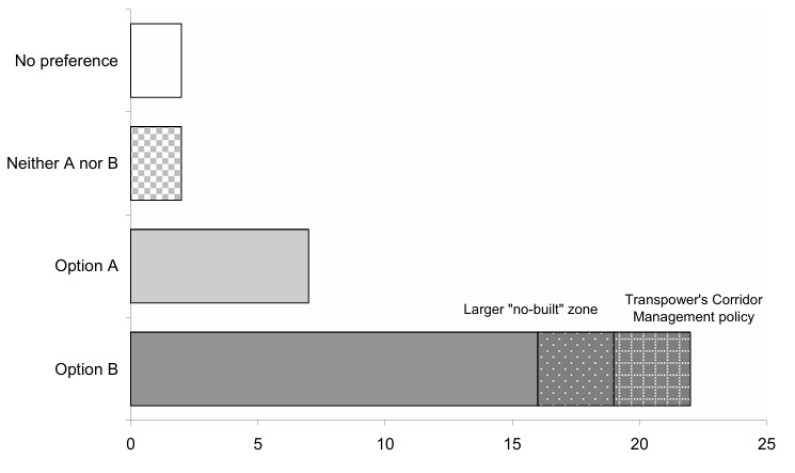
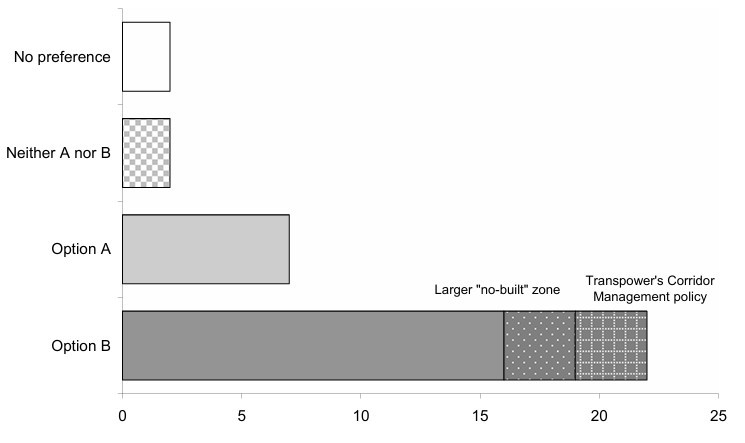
Seven submitters, while opposing the proposed transmission risks NES in general, preferred building Option A over Option B.4 Option A was thought to be less arbitrary, closer to the status quo, and allowed for more flexibility and the greatest possible freedom to landowners to develop their properties by allowing for under-building. Option A was also believed to align the NES with the existing NZECP 34, as well as with the RMA. One submitter, who supported the NES, favoured Option A but noted this could still constrain the ability of other network utility operators to install, maintain and upgrade services adjacent to transmission lines (eg, buried cables).
The majority of submitters (22) preferred building Option B, with a 20-metre “no-build” zone on each side of the transmission line, mainly because this:
-
would enforce a higher standard of safety
-
is relatively simple, is more practical and workable in terms of administration, and is easier to assess
-
assures a predetermined safety zone
-
provides clear directions for any construction operations.
Of this group, one regional council, two individual submitters and the National Radiation Laboratory would prefer a larger “no-built” zone, but in the absence of other solutions, supported building Option B. Three submitters from the electricity industry, while supporting Option B over Option A, would prefer a modified option based on Transpower Corridor Management Policy (see “Alternative building options” below). Two submitters did not have any option preference, perceiving that both have advantages and disadvantages, while two others disliked both options as neither had any merit from the perspective of landowner interest or land use in general.
4 Option A follows the provisions of the New Zealand Electrical Code of Practice (NZECP 34), and so would allow under-building.
Option B provides for a 20-metre zone each side of the transmission line, such that a resource consent would be required for any buildings or structures.
Figure 7 summarises submitters’ preferences for proposed building options, and shows modifications suggested by a number of respondents.
Figure 7: Building options preferred by submitters
Alternative building options
A number of alternative building options were proposed by submitters.
Three submitters, including a territorial authority, a landowner and an individual, recommended adopting an approach based on compliance with NZECP 34, together with a new national standard addressing EMF issues (see section 3.8).
One NGO suggested that establishing easement strips of 400 metres and 600 metres would be prudent for 220 kV and 400 kV lines, respectively, in order to take account of potential adverse health effects on people living in the proximity of transmission lines.
Transpower supported Option B in principle, but noted that the 20-metre zone is not wide enough, given the swing on long spans and consideration of wider risks, and therefore suggested amending this option. Transpower advocated a new approach that would involve creating a 12-metre non-complying zone on each side of the centre line and a restricted discretionary zone a further 20 metres outside the 12-metre zone. Submitters from the electricity industry noted that such a solution would be in line with Transpower’s current Corridor Management Policy and was considered to be more user-friendly for developers, councils and the general public.
Two other electricity industry submitters supported the new building option proposed by Transpower. The National Radiation Laboratory expressed a preference for Option B but noted that the separation distances for long-span high-voltage lines in NZECP 34 are greater than the 20-metre proposal, and that greater separation distances would have benefits in terms of reducing potential exposure to EMF (see section 3.8).
Definitions of buildings and structures
A number of submitters thought the definitions of “structures” and “buildings” should be clarified for the purpose of this NES. Five submitters made suggestions for the appropriate definition of “buildings”, proposing that habitable buildings be included in the definition. One regional council noted that if the intention is to protect human health, restricting the definition to habitable buildings would be sufficient, but if it is to protect transmission lines then the definition should include a wider range of structures. One industry sector submitter suggested the definition of “structure” should exclude structures up to 3 metres high and 10 square metres in floor area, and emphasised the need for utility cabinets to be exempt from the definition. Two territorial authority submitters suggested that the definition of “buildings” and/or “structures” be amended to capture structures of significant size and habitable buildings, while excluding minor structures, such as bridges, culverts, sheds and fences.
Cost−benefit appraisal
Range and accuracy of the cost−benefit analysis
The lack of a full cost−benefit analysis accompanying the proposed NES was a major criticism of the process. Out of 42 submissions addressing the issue of cost−benefit analysis (Questions 15 and 16), only three supported the accuracy and range of estimation. The general view was that the costs and benefits were analysed solely from the point of view of the line owner, rely heavily on Transpower estimates, and were included very selectively. As a result, it was claimed that the analysis is inaccurate and unreliable. Four submitters suggested that the analysis needs to include a more balanced and realistic approach in relation to additional costs imposed on the wider community, councils and affected landowners. Several submitters saw the proposal as a transfer of costs from Transpower to landowners and local authorities, and a sequestering of property rights. One noted that if the line owner is the only beneficiary of the standards, then the line owner should pay the costs of implementing them. Another noted that the Government’s contribution of only $200,000 towards implementing the standards is at odds with the claim that the proposal is of national importance. One landowner felt that it is unlikely that electricity prices will go down due to diminished grid costs.
Council costs
Eleven submitters noted that implementing the standards as proposed would result in a considerable increase in enforcement and monitoring costs for councils, especially in terms of changing their plans to comply with the NES, and that these costs were understated in the analysis. One council noted that the cost−benefit analysis lacked sufficient detail and robustness for councils to assess the additional resources required, and that the assumed costs to councils seemed very low. The majority of councils making submissions on the proposals indicated that they would be likely to undertake plan changes to incorporate the NES into their plans. It was estimated that at a suggested cost of $50,000 per council, the total cost would be around $3.5 million. However, it was proposed that these plan change costs could be minimised if standards were completed prior to second-generation plan reviews. The enforcement responsibilities were thought to create potential liabilities for councils if, for example, a council approves an activity adjacent to a transmission line which subsequently causes damage to the line, likened by one submitter to the “leaky homes nightmare”. Such costs have not been considered in the cost−benefit analysis. A number of submitters questioned how the estimated implementation cost to councils in the first two years was derived.
Landowner costs
Eight submitters were concerned that costs to individual landowners were only briefly mentioned in the text of the discussion document and were largely overlooked in the actual analysis. A number of submitters emphasised the fact that the cumulative cost of $7 billion dollars imposed on a small portion of the community required more justification, and an explanation of how this figure was reached. Several submitters noted that the analysis does not Proposed National Environmental Standards for Electricity Transmission: Report on Submissions 26 take account of the sequestration of property rights, the unrecoverable costs of landowners hosting transmission lines, and the changes to this under the NES.
One submitter suggested that a cost−benefit analysis should include an assessment of the potential liabilities to individual landowners due to accidental damage or outages. The draft economic appraisal was also criticised for not identifying the costs of restrictions on land use. One landowner estimated that the annual unrecoverable cost of hosting transmission lines would be $4.60 per linear metre of line per year for agricultural operations. The landowner then reported the cost of Option B for the transmission risks NES to be $20 to $30 per linear metre for dairy farms ($20,000 to $30,000 per linear kilometre), taking into account restrictions on land use, the value of capital improvements and the capacity of owners to undertake works. Submitters claimed that rural and urban landowners would be affected differently, with the latter facing a more severe loss of property value, which has not been taken into account in the evaluation.
Individual submitters noted that risks to residential property owners from transmission lines were not accounted for in terms of the financial analysis.
Benefits of the proposed standards
One industry submitter noted that the net present value (NPV) of the proposed standards was miniscule compared to other potential improvements that could be facilitated by government or Electricity Commission actions. One submitter noted that without an NES, consent authorities would progressively remove inconsistent consent requirements as a result of Transpower advocacy, which would erode the claimed NPV of the proposed standards to the level where it was not worthy of further consideration. The claimed benefits of the transmission risks NES were thought to be no more than a shift of who bears the risks along with a wealth transfer, rather than any gain in economic efficiency.
Three submissions from the electricity industry noted that the range of benefits from implementing the proposed standards might be greater than anticipated due to the large benefits of achieving the objectives of both the New Zealand Energy Strategy and the New Zealand Energy Efficiency and Conservation Strategy. These submitters predicted that the New Zealand economy would benefit from the standards due to the expansion of the transmission network and electricity network as a whole, and increased security of supply through a robust RMA framework. However, the benefits from the proposed transmission activities could be lower than estimated if the NES imposes additional resource consent requirements on transmission activities.
One individual submitted that there is inadequate consideration of the benefits of alternative mechanisms (eg, the Minister’s call-in powers, easement agreements etc.), and the benefits of the NES do not appear to outweigh those of other alternatives (see section 3.2.3 on consideration of alternatives).
Requirements of section 32 of the RMA
Nine submitters commented that the analysis would not be sufficient to meet the requirements of section 32 of the RMA. Section 32 requires consideration of the extent to which the objective is the most appropriate way to achieve the purposes of the RMA, and whether, having regard to their efficiency and effectiveness, the methods are the most appropriate for achieving the objective(s). One submitter thought the cost−benefit analysis would not meet the requirements of section 32 of the RMA because neither costs nor benefits for people and wider communities were considered. Two submitters noted that the RMA does not require that a section 32 analysis be prepared until the actual regulations are made, but thought a preliminary section 32 analysis should be available at the time of public consultation on proposals.
Electricity Act and land ownership issues
Submitters expressed concern about the proposed standards conflicting with the Electricity Act 2002 and having significant effects on landowners whose properties host electricity transmission corridors. Twenty-six submitters addressed the potential effects on landowners, and seven commented on the Electricity Act. Most of the comments on the Electricity Act and land ownership issues were received from landowners, but individuals, NGOs, the electricity industry, other industries and local government also stated their views.
Electricity Act issues
Seven submitters (five landowners, one NGO and one individual) expressed concern at the possibility of unlimited access to land by Transpower’s contractors, and three submitters cited examples of conflicts with Transpower’s contractors over timing of access or compensation for damage.
The Electricity Act provides Transpower with the right to access and maintain transmission lines provided there are no “injurious effects”. Submitters expressed the view that a number of proposed NES-permitted activities would result in encroachment, and in consequence, as established by the 2007 Fernwood Dairies Environment Court ruling (see p. 14), an injurious affect. One landowner questioned whether a substantially upgraded line should still qualify for the access provisions in the Electricity Act for pre-1988 lines, and noted that the Electricity Act was amended in 2001 to allow for “maintenance” to include “upgrading”, without consulting landowners.
Submitters also thought that allowing for activities not authorised by section 23.3 of the Electricity Act would compromise the interests of landowners and the purpose of that section of the Act. They suggested that the proposed standards would incorrectly signal that all scheduled activities, not authorised under section 23.3 of the Electricity Act, can be lawfully undertaken, which could be in conflict with the Act. One submitter expressed concern that if the proposed standards proceed, councils could be dragged into legal feuds between Transpower and landowners.
Effect on landowners
The possibility that the proposed NES will impose costs, obligations and liabilities on landowners, with no benefits or compensation offered was raised in all the submissions from landowners and many submissions from local government and individuals. Landowners feared that the standards as proposed would result in restrictions on development and therefore lead to property devaluation. Expropriation of $7 billion worth of value with no acknowledgement or compensation was highlighted in landowners’ submissions. One submitter stated that the proposed NES relegates landowners to third parties, stripping them of dignity and property rights to use their own land.
Another issue mentioned was that landowners would have to apply for more resource consents while Transpower would need fewer as a result of the proposed standards. Such a situation was thought by submitters to be against natural justice and would result in restrictions on landowners’ usual activities, such as cropping, viticulture, horticulture, silviculture, and the use of modern mechanical harvesting, as well as the opportunity for land subdivision. One submitter pointed out that farming methods and technology have changed substantially since the transmission lines were built, and land-use options are increasingly restricted. Furthermore, some lines have been upgraded, increasing the impact on landowners without any compensation. This submission stated that the government is allowing Transpower to break Article 17.2 of the Universal Declaration of Human Rights by allowing arbitrary deprivation of property.
One submission pointed out that the proposed standards will not affect all landowners equally and that the loss of value would only apply to a small proportion of landowners; this, however, does not lessen the importance of the issues raised. Another submitter acknowledged that achieving sustainable management often requires the use of tools that have an impact on land use and considered these tools appropriate.
Landowners generally felt that negotiated easement agreements, with fair compensation paid for hosting transmission lines and restricting activities around the lines, would resolve the issues intended to be addressed by the transmission risks NES proposal. Such an approach would not impose costs and loss of property rights on landowners. One submitter suggested that Transpower should be given direction by Cabinet to do this.
Electric and magnetic fields
Nineteen submitters raised the issue of extremely low-frequency electric and magnetic fields (EMF) associated with high-voltage transmission lines. Submitters stated that the standards should address EMF through permitted activity terms and conditions and separation distances. They also suggested that clarification would be needed on the exposure limits to be used, and matters over which councils can exercise control or discretion. The general theme of these submissions was that locating occupied buildings under transmission lines should be avoided wherever possible in order to avoid potential health impacts. However, submitters differed in their views on the likelihood of exposure causing health impacts, appropriate exposure limits, and mechanisms for ensuring a corridor is established.
The National Radiation Laboratory (NRL) of the Ministry of Health supports protecting people against the effects of exposure to EMF through compliance with the internationally recognised International Committee on Non-Ionising Radiation Protection (ICNIRP) guidelines, and low or no-cost measures to reduce or avoid exposure. The NRL was not convinced that maintaining a corridor beneath transmission lines free of occupied buildings would be a “low or no-cost measure”. If a corridor were to be established for other reasons, such as electrical safety, then there would be additional benefits from reducing EMF exposure. The NRL supported giving greater weight to maintaining corridors clear of regularly occupied buildings, and adding consideration of minimising exposure to EMF fields to matters to which discretion applies. NZECP 34 separation distances for 220 kV lines may be greater than the 20 metres proposed in the NES, and this would further reduce exposure to EMF.
One NGO submitter proposed that the 100 microTesla (μT) magnetic field standard was out of date, and suggested that international best practice was now 0.4 μT and a 30-metre exclusion corridor. Another NGO submitter provided an extensive review of international research on the health effects of EMF. This submission also proposed that the 100 μT limit is out of date, and that it should be revised to 0.1 μT. The submission stated that no studies have been done on populations exposed to 100 μT because the field strength beneath transmission lines is generally at most 5 μT under the line, and possible effects have been observed at 0.4 μT. It went on to say that nationally imposed limits range from 100 μT and prudent avoidance in the UK, Australia and New Zealand, to 10 μT in Italy, and as low as 0.4 μT in the Netherlands.
One NGO submitter suggested that wider corridors should be imposed whether or not the adverse effects of EMF can be demonstrated, and quoted the recommendations of the UK Stakeholder Advisory Group on ELF EMF (SAGE) report in support of this suggestion. Three submitters noted that the Reference Group report in 2006 recommended incorporating part of the draft standard under development by the Australian Radiation Protection and Nuclear Safety Agency, but the proposed NES does not mention taking a precautionary approach, as recommended by the Australian body. Submitters felt that more national guidance is needed to assist local authorities. Two submitters proposed that practical precautionary steps should be investigated to reduce EMF exposure from existing lines (eg, phasing, radial circuits, undergrounding) in line with SAGE and World Health Organisation recommendations.
Nine submitters noted that the failure of the proposed NES to cover EMF was a weakness in the proposals, and these submitters proposed this should be corrected by reference to international guidelines (ICNIRP) or an agreed national standard. Submitters saw this as following logically from the policy on EMF in the proposed NPS.
Transpower noted that epidemiological research on the health effects of EMF is inconclusive, and that the ideal outcome would be for the perceived health effects to be managed in a way that establishes internationally recognised levels, promotes public confidence and provides guidance on compliance. The permitted activity terms and conditions limit the extent of upgrades, and Transpower supports this approach. Transpower has a corporate commitment to manage EMF, including designing new and up-rated infrastructure to meet ICNIRP guidelines and following prudent avoidance. Transpower consider that if an exposure limit were added as a condition for permitted activities, it would be difficult for council officers to easily assess. Transpower strongly opposed using ICNIRP guidelines as a permitted activity standard because the guidelines are not specific enough, and strongly opposed using limits on up-rating or capacity (MVA) limits to control EMF, as it would provide poor control. Councils need the ability, when assessing controlled and restricted discretionary activities that could result in an increase in carrying capacity, to assess whether any change in EMF would be consistent with the ICNIRP guidelines. Transpower consider that the potential for radiofrequency interference and electromagnetic interference is minor and does not need controlling in the NES.
Implementation issues
The implementation process
Twenty-nine submitters commented on the proposed NES implementation process. The main issues raised included financial aspects of the implementation of the standards, and creating new administrative and enforcement functions for local authorities.
In terms of the financial aspects of implementation, the majority of comments related to the transfer of costs from Transpower as line owner to councils and, in effect, to ratepayers. Seven local authority submitters pointed out that additional operational costs associated with monitoring and enforcement of the standards would be imposed at a local level. Therefore, as suggested by one of the territorial authorities, issues such as providing support for local government and effective analysis of costs and benefits at this level need to be addressed. One submitter suggested that implementation costs should be apportioned fairly between Transpower, and central and local government. Other local authority submitters noted that local authorities may not currently have the expertise required to implement the standards. One NGO pointed out that shifting responsibility − with funding implications but no clear benefit − to local government is inconsistent with the Department of Internal Affairs’ Guidelines for Regulatory Functions Involving Local Government.
Two regional councils commented on the implementation process, with one noting that monitoring and enforcement will be prioritised against other resource management issues once the proposed NES are in place. Several local government submitters emphasised the importance of a clear division of responsibilities for regional and district councils, especially with regard to earthworks, as this activity is covered by both types of councils (albeit for different effects). Clarification on boat ramps and damming/diverting water was also sought. One local authority queried the status of NZECP 34 if the proposed transmission risks NES were implemented.
Thirteen responses were received from landowners, with 11 claiming that the proposed NES implementation process will transfer responsibility to third parties and result in an increased number of RMA applications for activities currently permitted, and two noting the cost transfer from Transpower to local government and taxpayers. Transpower commented that given the complexity and novelty of the proposed NES and potential for future regulatory change, the Ministry for the Environment needs to commit to reviewing the NES at regular intervals.
Six comments were received from individuals and NGOs on this issue. Two submitters acknowledged the need for regular reviews to allow for enhancing the standards and taking account of technological advances, and one noted that new responsibilities for local authorities to regulate and administer the standard will be created. One submitter emphasised the transfer of compliance and enforcement costs to regional and local authorities. Another respondent, apart from acknowledging the shift in responsibilities, suggested that the cost of altering district or regional plans can be minimised if the timing of the introduction of the proposed NES coincides with the second-generation plan reviews.
One individual and two NGOs noted that the RMA does not allow for standards to be incorporated into plans without going through a consultation process, and suggested that a change to the Act to allow this would assist council implementation. One territorial authority noted that the format of the proposed standards in the discussion document is inconsistent with most plans.
The effect of the proposed standards on designations was also mentioned as one of the matters to be addressed and clarified, as well as the potential for creating a “permitted baseline” for other activities that involve overhead wires and support structures.
Guidance
Submitters requested specific guidance on some aspects of the proposals, and raised a number of issues in relation to the proposed standards that could be addressed through guidance.
Thirteen submitters indicated the need for NES guidance in order to specify the range of duties for local authorities, and to provide detailed information on the notification of resource consents, managing adverse effects, evaluation of risk and transmission activities and related matters.
Regional councils were particularly concerned at the absence of a clear distinction between functions carried out by territorial authorities and those carried out by regional authorities. Submitters noted that there may be a great deal of confusion over who is the responsible authority for NES compliance and enforcement issues, particularly for activities such as earthworks and abrasive blasting.
Territorial authorities were mainly concerned with the lack of clarity over what happens if there is a difference between the proposed NES and plan definitions, and sought guidance on notification of consent applications, affected party status and whether existing plan notification requirements will apply. One territorial authority suggested that providing explanations and anticipated outcomes for each activity covered by the proposed NES would help the assessment of resource consent applications. Another noted that assistance would be needed to educate the public about any new standards.
One of the territorial authorities wanted guidance on determining the status of emergency works under the proposed NES. Another noted that guidance on the potential adverse effect of electromagnetic fields will be required.
One local government representative suggested that guidance is also needed on which activities are “directly associated with the inspection, operation, maintenance or enhancement of an existing transmission line”, as well as on consent requirements for projects where activities fall within more than one category. This submitter suggested that providing examples of how the proposed NES should be applied to projects would be of great assistance to local authorities.
Landowners were interested in receiving more explanation on how their existing-use rights will be affected by the introduction of the proposed NES.
A number of submitters requested that a number of definitions included in the discussion paper be clarified. According to one of the regional councils, terms such as “operation”, “maintenance” and “upgrading” need to be clarified to avoid confusion. A unitary authority noticed that two definitions were given for “earthworks”, and that the definition for “building or structure” was uncertain and unworkable. Another remarked that the definitions provided were likely to be different from local authority plan definitions.
One of the local authorities suggested that visual aids (eg, diagrams, illustrations, etc.) should be used to explain technical terms.
Transpower expressed a readiness to work in partnership with the Ministry for the Environment and Local Government New Zealand in preparing guidance material and assisting with the implementation of the proposed standards. Suggested topics included:
- the intention and scope of the NES
- clarifying the relationship with district and regional plans (eg, earthworks)
- applying the NES requirements to projects
- technical terms, transmission components and functions and transmission activities
- giving examples of standard conditions
- providing guidance on specific NES topics such as noise, EMF, historic heritage and vegetation
- identifying best practice for cultural, heritage and archaeological site disturbance
- clarifying controls in the CMA, lakes and rivers, and guidance on duration.
For the proposed risks NES, Transpower considered guidance would be needed on:
- activities outside the NES but which may still adversely affect transmission lines
- the relationship between NES requirements and plan requirements.
Process and consultation
Thirty-four comments were received on the proposed NES process and consultation.
Eighteen comments were from landowners, most of which pointed out issues with the consultation process, such as:
- inadequate notification of landowners
- insufficient time available to comment on the proposals
- no hearings and no opportunity to present evidence in support of submissions
- no opportunity for making further submissions or Environment Court appeals.
A lack of awareness among landowners about the ongoing consultation process due to inadequate notification (only one public notice in each area) was signalled as being a major drawback in the process. Two submitters suggested that landowners were not well represented on the original Reference Group. The number of workshops conducted was also felt to be too small. Several respondents thought that all affected landowners should have been directly notified of the proposals.
Ten comments were made by individuals and NGOs, with three suggesting there should be provision for further input once the submissions are received and opportunity for review and comment on the draft regulations before their formal propagation. One submitter suggested the consultation process should be tailored for each of the proposed NES separately, and should be more transparent and accountable. Another NGO noted the need for a more equitable process, where provision for the participation of landowners and other interests is more inclusive and a rural impact assessment is incorporated into the process. One individual noted that consultation with the “many sovereign Maori nations and their interests and relationship to sites of importance” was not provided for. Conducting public hearings was also suggested.
Four comments on the NES process and consultation were received from territorial authorities. One suggested that a second round of consultation and wider workshop sessions should be considered in order to add transparency to the process, and one was concerned about the level of consultation undertaken. One territorial authority felt the process was unsatisfactory and suggested submitters have the opportunity to comment on a revised draft. One regional council also noted that good practice would involve notifying landowners adjacent to the existing lines so that they could be fully involved in the consultation process.
One electricity industry submitter acknowledged that the proposed standards are complex and highly technical and requested an opportunity to review the draft regulations for workability, clarity and certainty. Several local authorities also asked to be involved in preparing the final NES proposals.
Links with the National Policy Statement on Electricity Transmission
A National Policy Statement (NPS) on Electricity Transmission was gazetted on 13 March 2008, and the rules took effect on 10 April 2008.
Ten submitters stressed the importance of the proposed NES being aligned with the NPS on electricity transmission. Although views on implementation issues varied, it was clear that submitters considered that ensuring the standards are consistent with national policy direction is paramount.
In terms of NPS and NES implementation, three submitters said it would be preferable to publicly notify the NPS at the same time as the proposed NES. Four submitters suggested the NPS should be finalised and implemented prior to the NES introduction. One noted there should be a second round of comment on the NES once the NPS is in place.
One electricity industry submitter proposed that the NES should incorporate the national policy direction following the final report on the NPS. One territorial authority suggested that once the proposed NPS on electricity transmission is finalised, consideration should be given to ensuring the proposed standards are still in accordance with the framework of objectives and policies outlined in the NPS. One regional council noted that changes requested to the proposed NPS − such as minimising adverse effects on urban amenity, town centres and areas of high recreational or amenity value − should be taken into account in the NES once the NPS is finalised. One submitter saw the NPS requirement to show transmission lines on planning maps as complementing the NES proposals.
According to one regional council, the discussion document on the proposed NES does not indicate in any way how the proposed standards support or link with the strategic national direction of the NPS. Moreover, one of the landowners claimed the discussion document is “ambiguous and confusing” on the relationship between the proposed NES and the proposed NPS, and their implementation.
However, in general the submissions recognised the importance of the NPS and the proposed NES being closely aligned and consistent with each other if they were to provide effective and robust industry direction.
The following public notice appeared in regional and national newspapers.
National environmental standards for Electricity transmission Call for submissions
In accordance with section 44 of the Resource Management Act 1991, the Minister for the Environment gives notice of the Government’s intention to develop two national environmental standards (regulations) for electricity transmission.
The intent of the proposed standards is to ensure adequate protection of the national grid, and national consistency in how the operation, maintenance and upgrading of the grid is managed.
The proposed standards do not cover the construction of new transmission lines. The proposed standards are consistent with the purpose of the Resource Management Act as they promote the use, development and protection of the national grid (a physical resource) in a way that enables people and communities to provide for their social, economic and cultural wellbeing, and their health and safety, while protecting the environment. The proposed standards would do this by controlling (subject to specified limitations):
-
the environmental effects of the operation, maintenance and upgrading of the national grid by the grid owner
-
activities carried out by third parties adjacent to the national grid which could damage the grid or put it at risk.
A discussion document outlining the subject matter and rationale of the proposed standards has been produced by the Ministry for the Environment to help people make submissions. This document can be viewed at the Ministry for the Environment, 23 Kate Sheppard Place, Thorndon, Wellington and online at www.environment.govt.nz If you would like a printed copy of the discussion document, free copies are available by emailing your request to publications@mfe.govt.nz or by phoning (04) 439 7467.
Any person can make a submission on the subject matter of the proposed standards. Please include the following information in your submission:
- Your name, postal address, phone number and email address (if applicable).
- That you are making a submission on the proposal to develop national environmental standards for electricity transmission.
- Whether you support or oppose the proposed standards as detailed in the discussion document.
- Your submission with reasons for your views.
- Any changes you would like made to the proposed standards as detailed in the discussion document.
- The decision you would like the Minister for the Environment to make.
Please send your submission to the Ministry for the Environment, PO Box 10362, Wellington or email to standards@mfe.govt.nz by 5 pm on Friday 30 November 2007.
| No. | Company | Name | Category |
|---|---|---|---|
|
Maniapoto Maori Trust Board |
Glen Katu |
Iwi |
|
|
2 |
Hawke’s Bay Regional Council |
Emma O'Neill |
Regional council |
|
3 |
Perry Group Ltd |
Bill Mitchelmore |
Landowners |
|
4 |
The Local Lockup Ltd |
Scott Palmer |
Landowners |
|
5 |
John Yelverton |
Landowners |
|
|
6 |
Waipa District Council |
Garry Dyet |
Territorial authority |
|
7 |
Rob Storey |
Individual |
|
|
8 |
Environment Bay of Plenty |
Mary-Anne Macleod |
Regional council |
|
9 |
Tasman District Council |
Dennis Bush-King |
Unitary authority |
|
10 |
Lance and Donna Levesque |
Landowners |
|
|
11 |
Roger Baldwin |
Landowners |
|
|
12 |
Delia Meier |
Landowners |
|
|
13 |
Steve Meier |
Landowners |
|
|
14 |
Southland District Council |
Mark Bailey |
Territorial authority |
|
15 |
TrustPower Limited |
Gavin Kemble |
Electricity industry |
|
16 |
The Onehunga Enhancement Society |
Jim Jackson |
Landowners |
|
17 |
Jenkin Timber Ltd |
Richard Carbines |
Landowners |
|
18 |
Kapiti Grey Power Inc |
Terry Bicknell |
Non-governmental organisation |
|
19 |
New Era Energy 2 |
Robert McQueen |
Non-governmental organisation |
|
20 |
Carter Holt Harvey |
Murray Parrish |
Landowners |
|
21 |
National Radiation Laboratory |
Martin Gledhill |
Government |
|
22 |
Environment Waikato |
Katie Mayes |
Regional council |
|
23 |
Adrian Kinsler and Laura Bennett |
Individual |
|
|
24 |
Onehunga and Districts RSA |
Rona McKenzie |
Non-governmental organisation |
|
25 |
Jackson Electrical Industries Ltd |
Jim Jackson |
Landowners |
|
26 |
Far North District Council |
Clive Manley |
Territorial authority |
|
27 |
Transit New Zealand |
Lisa Rossiter |
Government |
|
28 |
Palmerston North City Council |
Matthew Mackay |
Territorial authority |
|
29 |
Samson Corporation Ltd and Sterling Nominees Ltd |
Landowners |
|
|
30 |
Amphora Investments Ltd and Parkinson & Bouskill Ltd |
Peter Gibson |
Landowners |
|
31 |
MP Alexander |
Individual |
|
|
32 |
Aggregate and Quarry Association of NZ |
Renee Murphy |
Landowners |
|
33 |
Jon Mapes Land Solutions Ltd |
Jon Maplesden |
Landowners |
|
34 |
Rodney District Council |
Peter Vari |
Territorial authority |
|
35 |
New Era Energy |
Robin Smart |
Non-governmental organisation |
|
36 |
Manukau City Council |
Pat Holm |
Territorial authority |
|
37 |
Napier City Council |
Alastair Thompson |
Territorial authority |
|
38 |
Nelson City Council |
Reuben Petersen |
Unitary authority |
|
39 |
The James Trust |
James Kirkpatrick |
Landowners |
|
40 |
Ann Flannagan |
Landowners |
|
|
41 |
Demler Planning Services |
Robert Demler |
Individual |
|
42 |
Keith Hay Group |
David Hay |
Landowners |
|
43 |
South Waikato District Council |
Alan Moss |
Territorial authority |
|
44 |
Federated Farmers |
Richard Gardner |
Landowners |
|
45 |
Rural Women New Zealand |
Noeline Holt |
Non-governmental organisation |
|
46 |
Auckland City Council |
Des Hughes |
Territorial authority |
|
47 |
Hancock Forest Management |
Sally Strang |
Landowners |
|
48 |
Mighty River Power Ltd |
Rob Hunter |
Electricity industry |
|
49 |
Greater Wellington Regional Council |
Nicola Shorten |
Regional council |
|
50 |
Property Council of New Zealand |
Daniel Newman |
Landowners |
|
51 |
Northland Regional Council |
Vaughan Cooper |
Regional council |
|
52 |
New Zealand Historic Places Trust |
Nicola Jackson |
Government |
|
53 |
Local Government New Zealand |
Eugene Bowen |
Non-governmental organisation |
|
54 |
Resource Management Law Association |
Martin Williams |
Non-governmental organisation |
|
55 |
Bridget Graham |
Individual |
|
|
56 |
Franklin District Council |
Linda Albertyn |
Territorial authority |
|
57 |
Southpark Corporation |
Peter Sanders |
Landowners |
|
58 |
Holcim (New Zealand) Ltd |
David Willetts |
Other industry |
|
59 |
Meridian Energy |
Hamish Cuthbert |
Electricity industry |
|
60 |
North Shore City Council |
Ewen Patience |
Territorial authority |
|
61 |
Jeremy Brook |
Individual |
|
|
62 |
Bruce Davidson |
Individual |
|
|
63 |
Vector Ltd |
Ewan Gebbie |
Electricity industry |
|
64 |
Telecom |
Vicki Willis |
Other industry |
|
65 |
Auckland Regional Council |
Matthew Richards |
Regional council |
|
66 |
Eastland Network |
Henrike Seifert |
Electricity industry |
|
67 |
Environment Canterbury |
Andrew Willis |
Regional council |
|
68 |
Environment and Conservation Organisations of NZ Inc |
Barry Weeber |
Non-governmental organisation |
|
69 |
Sexton Farms Ltd |
John Sexton |
Landowners |
|
70 |
Graham Halstead |
Individual |
|
|
71 |
Major Electricity Users Group |
Ralph Matthes |
Other industry |
|
72 |
Kapiti Coast District Council |
David Hattam |
Territorial authority |
|
73 |
Waikato District Council |
Kate Mackness |
Territorial authority |
|
74 |
Ron Walden |
Individual |
|
|
75 |
Contact Energy Ltd |
Jan de Bruin |
Electricity industry |
|
76 |
Unison |
Amanda Reid |
Electricity industry |
|
77 |
Hamilton City Council |
Sarah Ward |
Territorial authority |
|
78 |
Electricity Engineers' Association of New Zealand |
Peter Berry |
Non-governmental organisation |
|
79 |
Waitakere City Council |
Kyle Balderston |
Territorial authority |
|
80 |
Transpower New Zealand Ltd |
Jenny Chetwynd |
Electricity industry |
|
81 |
Westpower Ltd |
Martin Kennedy |
Electricity industry |
|
82 |
West Coast Regional Council |
Grant Trenwith |
Regional council |
|
83 |
Rotorua District Council |
Dagg Liam |
Territorial authority |
|
84 |
Hillsborough Gospel Trust |
LR Simmons |
Landowners |
The following questions were put forward for comment in the discussion document.
Question 1: Do you think national environmental standards are the most appropriate way of providing detailed national direction for management of the national grid?
Question 2: Do you agree with the objective? Do you think this objective meets the purpose of the RMA?
Question 3: Have we covered all the viable options for providing detailed national guidance under the RMA for the sustainable management of electricity transmission?
Question 4: Are the proposals for permitted activities likely to generate additional resource consent requirements?
Question 5: Should more activities be permitted than currently proposed? For example, earth peaks are permitted in many plans, and often increase the height of the tower by more than the 15 percent allowed in the proposed NES. Should earth peaks be permitted without a height allowance?
Question 6: Do you think the categories assigned to activities are appropriate? Are they too stringent, or too lenient? For example, putting existing overhead transmission lines underground is a restricted discretionary activity. Should this be a controlled or even permitted activity?
Question 7: Are the terms and conditions proposed to control the environmental effects of permitted activities appropriate? Are the matters over which the council can have control/discretion in assessing resource consents appropriate?
Question 8: Are there any other activities that should be listed in the transmission activities NES?
Question 9: Should the NES make any provision for activities to be “non-complying” (for example, some activities in the coastal marine area)?
Question 10: Should new transmission lines be covered in the NES?
Question 11: Do you have any comments on the activities proposed to be covered by the transmission risks NES? Is this the most appropriate way to manage these activities?
Question 12: Do you have any comments on the proposed activity types (prohibited, controlled, non-complying, restricted discretionary)?
Question 13: Which building option do you prefer and why? What should be the cut-off point for managing “buildings” (eg, all buildings and structures, only inhabitable buildings)? What about bridges and other structures? How could this be defined?
Question 14: Are there any other activities that should be managed to prevent risks to transmission lines? For example, damming and diverting water could endanger transmission support structures. Is this adequately controlled in regional plans now, or are additional provisions required?
Question 15: Have we accurately reflected the range of costs and benefits arising from the proposals for national environmental standards and who might bear the costs or receive the benefits? Are there any costs and benefits we have overlooked?
Question 16: Are our estimates of costs and benefits accurate? Do you have information on costs and benefits that could assist the second stage of our assessment (of the impacts of the final proposals)? Do you have any information on costs and benefits that we have been unable at this stage to quantify?
See more on...
Proposed National Environmental Standards for Electricity Transmission: Report on submissions
May 2008
© Ministry for the Environment