The Government has brought into effect national direction on managing natural hazard risk as part of its phased approach to the reform of the resource management system.
The Government has brought into effect national direction on managing natural hazard risk as part of its phased approach to the reform of the resource management system.
The Government has brought into effect national direction on managing natural hazard risk as part of its phased approach to the reform of the resource management system.
The National Policy Statement for Natural Hazards was notified in the New Zealand Gazette on 18 December 2025 and comes into force on 15 January 2026.
Find out more about the National Policy Statement for Natural Hazards.
1.1 Title
- This is the National Policy Statement for Natural Hazards 2025.
1.2 Commencement
- This National Policy Statement comes into force on 15 January 2026.
- See Part 4 for timeframes for giving effect to this National Policy Statement.
1.3 Application
- This National Policy Statement applies to the following natural hazards:
- flooding;
- landslips;
- coastal erosion;
- coastal inundation;
- active faults;
- liquefaction; and
- tsunami.
- This National Policy Statement applies to all activities managed under the Act, except for infrastructure (as defined in the Act) and primary production (as defined in the National Planning Standards).
- This National Policy Statement applies to all environments and all zones, including coastal environments. Where there is conflict between the provisions of this National Policy Statement and the New Zealand Coastal Policy Statement 2010, the New Zealand Coastal Policy Statement 2010 prevails.
- This National Policy Statement does not preclude decision-makers from managing natural hazard risk beyond the application of this National Policy Statement, including risks from other natural hazards and activities not otherwise covered, or from applying a more conservative approach to managing the natural hazard risks covered by this National Policy Statement.
- This National Policy Statement does not override any existing use rights that may apply under section 10 of the Act.
1.4 Interpretation
- In this National Policy Statement:
Act means the Resource Management Act 1991
commencement date means the date on which this National Policy Statement comes into force, as identified in clause 1.2
decision-maker means any person exercising functions or powers under the Act
high natural hazard risk means natural hazard risk assessed as ‘high’ using the risk matrix
medium natural hazard risk means natural hazard risk assessed as ‘medium’ using the risk matrix
risk matrix means the risk matrix, including likelihood and consequence tables, in appendix 1
significant natural hazard risk means natural hazard risk assessed as ‘medium’, ‘high’ and ‘very high’ using the risk matrix
very high natural hazard risk means natural hazard risk assessed as ‘very high’ using the risk matrix. - Terms defined in the Act and used in this National Policy Statement have the meanings in the Act, except as otherwise specified.
- Terms defined in the National Planning Standards issued under section 58E of the Act and used in this National Policy Statement have the meanings in the Standards, unless otherwise specified.
1.5 Incorporation by reference
- Clause 2(1) of Schedule 1AA of the Act does not apply to any material incorporated by reference in this National Policy Statement.
2.1 Objective
- Natural hazard risk to people and property associated with subdivision use and development is managed using a risk-based proportionate approach.
2.2 Policies
Policy 1: When considering natural hazard risk associated with subdivision, use or development, the risk level must be assessed using the risk matrix.
Policy 2: Natural hazard risk associated with subdivision, use and development must be managed using an approach that is proportionate to the level of natural hazard risk.
Policy 3: Where subdivision, use or development is assessed as having very high natural hazard risk, that risk must be avoided.
Policy 4: Where subdivision, use or development, including any associated mitigation measures, will create or increase significant natural hazard risk on other sites, that risk must be avoided or mitigated using an approach that is proportionate to the level of natural hazard risk.
Policy 5: Natural hazard risk assessment and decisions must be based on the best available information and must be made even when that information is uncertain or incomplete.
Policy 6: The potential impacts of climate change to at least 100 years into the future must be considered.
3.1 Overview of Part 3
- This Part sets out a non-exhaustive list of things that must be done to implement or give effect to the objective and policies of this National Policy Statement. Nothing in this Part limits the general obligation under the Act to give effect to that objective and those policies.
3.2 Risk-based assessment
- Natural hazard risk associated with subdivision, use or development must be assessed using:
- the likelihood of a natural hazard event occurring, in accordance with table 1, appendix 1; and
- the consequence of a natural hazard event for life and property, in accordance with table 2, appendix 1
to determine whether the level of natural hazard risk is low, medium, high or very high, in accordance with the risk matrix. - When assessing natural hazard risk, decision-makers must consider:
- existing and proposed mitigation measures; and
- residual risk that arises when design thresholds of any existing and proposed mitigation measures are exceeded.
3.3 Proportionate management of natural hazard risk
- Decision-makers must consider the scale and detail of information necessary to assess the risk by having regard to the anticipated level of risk.
- When managing natural hazard risk associated with subdivision, use and development, decision-makers must apply mitigation measures, including location and design, for the purposes of ensuring that:
- very high natural hazard risk is avoided;
- high or medium natural hazard risk is avoided or mitigated proportionate to the level of risk; and
- any creation of, or increase in, significant natural hazard risk on other sites is avoided or mitigated proportionate to the level of natural hazard risk.
- When applying the proportionate approach required by 2(b) and 2(c), decision-makers must take into account the cost effectiveness of mitigation measures relative to the level of anticipated risk.
3.4 Best available information
- When undertaking risk assessments and making decisions for the purposes of managing natural hazard risk, decision-makers must use the best information available at the time of making the assessment or decision.
- When information is uncertain or incomplete, decision-makers must continue to undertake risk assessments and make decisions using the best available information and not delay making decisions solely because of uncertainty about the quality or quantity of the information available.
- Decision-makers must give effect to this National Policy Statement on and from the commencement date, except as provided for in (2).
- Local authorities are not required to initiate changes to regional policy statements, regional plans or district plans within a specific timeframe for the sole purpose of giving effect to this National Policy Statement.
When undertaking an assessment of natural hazard risk, the following risk matrix and associated tables must be applied to enable assessment of the consequence level and likelihood level and to determine the level of natural hazard risk applicable.
Figure 1: Risk matrix

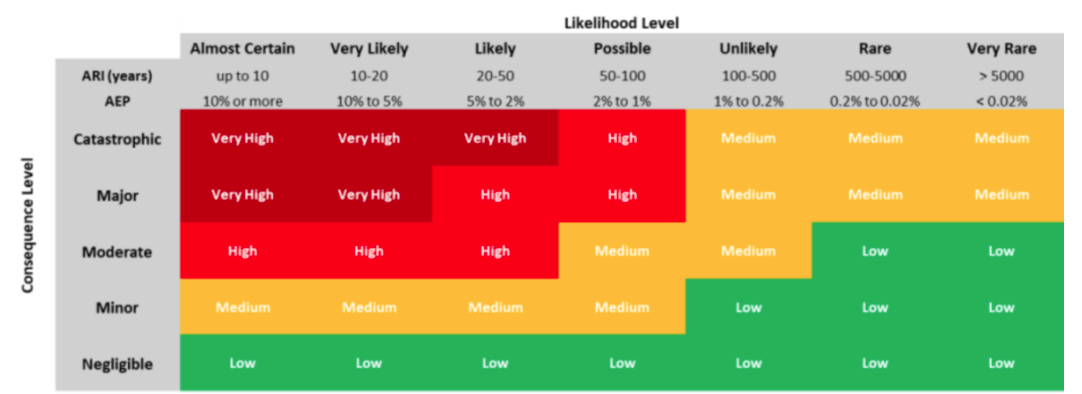
Note: The top end of the likelihood range includes the top end year, that is: Likely = over 20 years and up to and including 50 years.
Table 1: Likelihood table
| Likelihood level | Annual exceedance probability (AEP) | Average recurrence interval (ARI) or ‘return period’ |
|---|---|---|
| Almost certain |
10% or more |
Up to and including 10 years |
| Very likely | 10% to 5% | Over 10 and up to and including 20 years |
| Likely | 5% to 2% | Over 20 and up to and including 50 years |
| Possible | 2% to 1% | Over 50 and up to and including 100 years |
| Unlikely | 1% to 0.2% | Over 100 and up to and including 500 years |
| Rare | 0.2% to 0.02% | Over 500 and up to and including 5,000 years |
| Very rare | less than 0.02% | More than 5,000 years |
Table 2: Consequence table
| Consequence level | Damage to property | Potential for injury or fatalities |
| Catastrophic | Severe damage to land and building(s), potential for collapse or total destruction of structures. Building(s) need to be demolished, rebuilt or relocated. | High threat to life safety, with probable fatalities and/or critical injuries. |
| Major | Major damage to land and building(s), including structural damage. Loss of use and substantial repair required. | Unsafe for people, with potential for many injuries, or critical injuries and/or fatalities. |
| Moderate | Some damage to land and non-structural damage to building(s). Limited loss of use, repairs required. | Unsafe for people, with potential for injuries, although expected to be minor. |
| Minor | Minor damage to land and building(s). No loss of use, minimal repairs required. | Isolated minor injuries possible. |
| Negligible | No loss of use, no building repairs required. | No injuries. |
This note is not part of the National Policy Statement for Natural Hazards but is intended to indicate its general effect.
This National Policy Statement provides direction under the Resource Management Act 1991 for managing natural hazard risk associated with subdivision, use and development. It must be applied to flooding, landslips, coastal erosion, coastal inundation, active faults, liquefaction, and tsunami, and decision-makers may choose to use the same approach for other hazards.
Poorly located or designed development can increase exposure to natural hazards, creating significant risks for people, property and communities. These risks are expected to change over time, including through the effects of climate change. Consistent national direction helps reduce vulnerability and supports resilience.
The National Policy Statement requires decision-makers to assess risk using a risk matrix and manage it proportionately. Very high risk must be avoided, and other risks managed through mitigation measures. Decisions must be based on the best available information, even where that information is uncertain or incomplete.
This National Policy Statement does not apply to infrastructure (as defined in the Act) or primary production (as defined in the National Planning Standards). Where a conflict exists between the provisions of the New Zealand Coastal Policy Statement 2010 and this Statement, the New Zealand Coastal Policy Statement 2010 prevails. It does not override existing use rights under section 10 of the Act.
This National Policy Statement provides a baseline for managing natural hazard risk through planning. Where councils already have more stringent provisions in place, these should be followed.
Its purpose is to reduce the creation or increase of significant natural hazard risk and support communities to adapt to changing conditions.
| This is secondary legislation issued under the authority of the Legislation Act 2019 (New Zealand Legislation website). | |
| Title | National Policy Statement for Natural Hazards 2025 |
| Principal or amendment | Principle |
| Consolidated version | No |
| Empowering Act and provisions | Resource Management Act 1991, section 52 |
| Replacement empowering Act and provisions | N/A |
| Maker name | Minister for the Environment |
| Administering agency | Minister for the Environment |
| Date made | 15 December 2025 |
| Publication date | 18 December 2025 |
| Notification date | 18 December 2025 |
| Commencement date15 January 2026 | 15 January 2026 |
| End date (when applicable) | N/A |
| Consolidation as at date | N/A |
| Related instruments | N/A |
See more on...
National Policy Statement for Natural Hazards 2025 December 2025
December 2025
© Ministry for the Environment